
Introduction
Many people look to Canada’s Food Guide (CFG) as the ”measuring stick” as to whether they are eating a healthy diet, but did you know that over the years, CFG has changed dramatically? Canada’s first food guide, the Official Food Rules, was introduced to the public in July 1942. This guide acknowledged wartime food rationing while endeavoring to prevent nutritional deficiencies and to improve the health of Canadians. Over the years, the names of the food groups, the serving sizes, and the number of servings have changed. Serving sizes are now given in ranges, and one has to wonder if these changes have resulted in ”over-nutrition“.
Could there be a relationship between the rise in obesity rates after 1977 and Canada’s Food Guide shift to lower-fat, higher-carbohydrate diets?
Canada’s Food Rules — 1949

The post-WWII ”Canada’s Food Rules” of 1949 emphasized people taking in sufficient nutrients to prevent nutritional deficiency as well as to avoid excess, by stressing that ”more is not necessarily better“.
Adult guidelines promoted;
- 2 cups or more of full-fat milk
- 1 serving of citrus or tomatoes daily & 1 other fruit
- 2 serving potatoes plus 2 servings of other vegetables (preferably yellow or green and frequently raw)
- 4 slices of bread with butter and 1 serving whole grain cereal
- one serving of meat, fish, or poultry or dried beans, eggs (3x / week), cheese (3x / week)
- use liver frequently
Canada’s Food Guide — 1961
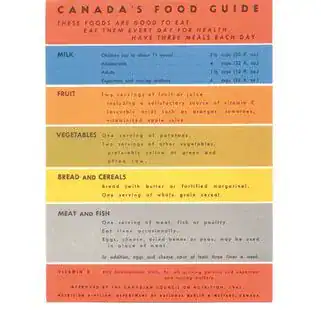
In the 1961 version, the language softened, with “Guide” replacing “Rules” in the title. Canada’s Food Guide sought to emphasize its flexibility and wide-ranging application for healthy eating, recognizing that many different dietary patterns could satisfy nutrient needs.
Adult guidelines promoted;
- 1 1/2 cups or more of full-fat milk (decreased by ½ cup)
- 1 serving of citrus or tomatoes daily & 1 other fruit
- 2 serving potatoes plus 2 servings of other vegetables (preferably yellow or green and frequently raw)
- 4 slices of bread with butter and 1 serving whole grain cereal
- one serving meat, fish or poultry, eggs (3x / week), cheese (3x / week) or dried beans
- use liver frequently
Reference: Nutrition Division, National Department of Health and Welfare (1961). Rules out – guide in. Canadian Nutrition Notes, 17(7):49-50 (cited in Health and Welfare Canada. Action towards healthy eating: technical report. 1990).
Canada’s Food Guide — 1977
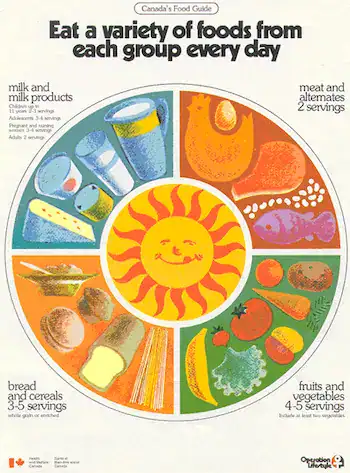
In 1977, Canada’s Food Guide underwent a dramatic revision. There were now four food groups, instead of five, as fruits and vegetables were combined since their nutrient content overlapped, and the names of those groups changed, too.
The Milk group became Milk and Milk Products, to highlight the inclusion of other dairy foods. Meat and Alternates replaced Meat and Fish, allowing for vegetarian choices — but also resulting in the inclusion of things like peanut butter in this category, rather than categorized in the fat category as occurs in other systems, such as the Food Exchanges.
Most significantly, serving ranges were added.
The big focus was on more carbs and less fats (regardless of what the sources of those fats were) — there was no differentiation between lard and olive oil. There was a shift to using low-fat dairy products, and the beginning of generations of ” fat-phobic” Canadians began. ” Low-fat” products became all the rage.
- 2 servings (skim, 2%, whole) milk, buttermilk or yogourt (1 serving = 1 cup milk, ¾ cup yogourt, 1 ½ oz cheese)
- 4-5 servings fruit & vegetables (at least 2 vegetables) – cooked, raw or fruit juices, include yellow or green or green leafy vegetables
- 3-5 servings of Bread and Cereal
- 2 servings Meat and Alternates – (1 serving = 2-3 oz lean cooked meat, fish or poultry, or 2 eggs or 1 cup dried cooked legumes, or ½ – 1 cup* nuts or seeds).
In 1977, there was the introduction of the concept of ”energy balance” balancing energy intake with energy output (”calories in / calories out” model), which makes the assumption that basal metabolic rates stay the same.
Intending to reduce diet-related chronic diseases (such as heart disease and high blood pressure), Canada’s Food Guide encouraged Canadians to reduce salt and fat, without distinguishing between sources of fats. In the process, the quantity of all kinds of fat, including healthy monounsaturated fats such as olive oil and nut and seed oil were all reduced. Canada’s Food Guide encouraged Canadians to eat plenty of fruits and vegetables without distinguishing between high fiber, non-starchy vegetables and high carbohydrate starchy vegetables. More on that below.
Before 1977, the obesity rate [measured as Body Mass Index (BMI) 30 kg / m2] of Canadian adults was <10%. Keep that number in mind. It changes considerably over the years as Canada’s Food Guide recommendations change.
Note: A report submitted to Health Canada in 1977 by the Committee on Diet and Cardiovascular Disease advised the government to take action to prevent diet-related chronic diseases such as heart disease and high blood pressure, so the emphasis in the revised 1982 Canada’s Food Guide was towards even lower-fat products.
Lower fat in products often meant more sugar (as fructose or high fructose corn syrup) being added to products such as yogourt, to help make up for the missing taste. Portions of nuts and seeds, which contain heart-healthy monounsaturated fats, were reduced in the ongoing push to lower all fat in the diet.
There was a continued shift towards carbs as the main source of calories; not only from Breads & Cereals, but from Fruit & Vegetables too — and in this category, there was no distinction between starchy vegetables (such as potatoes, peas, corn, squash, and yams) and non-starchy vegetables, such as salad greens or asparagus. As a result, a serving of sweet potato was categorized no differently than a serving of salad greens.
Furthermore, a serving of fruit juice was considered equivalent to a serving of fruit, with no concern for the fact that there was no fiber in the juice and significantly more carbohydrates per serving. Carbs were perceived as ”good” and fat was promoted as ”bad”. As a result of these changes, under this new Canada’s Food Guide, one could have 3 glasses of juice, one serving of potato, and a tiny salad and ”meet” the guidelines.
Canada’s Food Guide — 1982

Adult guidelines promoted;
- 2 servings (skim, 2%, whole) milk, buttermilk or yogourt (1 serving = 1 cup milk, ¾ cup yogourt, 1 ½ oz cheese)
- 4-5 servings fruit & vegetables (at least 2 vegetables) – cooked, raw or fruit juices, include yellow or green or green leafy vegetables
- 3-5 servings of Bread and Cereal
- 2 servings Meat and Alternates – (1 serving = 2-3 oz lean cooked meat, fish or poultry, or 2 eggs or 1 cup dried cooked legumes or ½ cup* nuts or seeds).
Reference: Ballantyne, R.M., Bush, M.B. (1980). An evaluation of Canada’s food guide and handbook. Nutrition Quarterly, 4(1):1-4.
Canada’s Food Guide — 1992
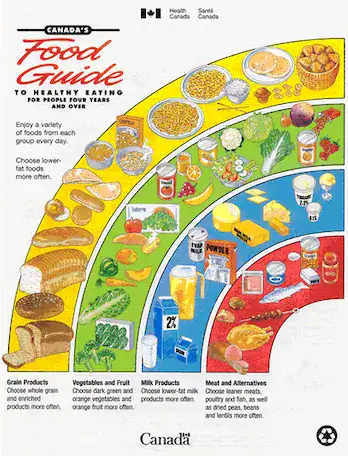
In 1992, Canada’s Food Guide became Canada’s Food Guide to Healthy Eating.
A new ”total diet approach” aimed to meet both energy (calories) and nutrient requirements resulted in large ranges in the number of servings in the four food groups.
To meet higher energy needs, the Guide encouraged selection of more servings from the Grain Products and Vegetables and Fruit groups — resulting in an even higher percentage of carbohydrates in the diet.
Adult guidelines servings changed as follows:
- 3-5 5-12 servings of Bread and Cereal
- 4-5 5-10 servings fruit & vegetables (at least 2 vegetables) – cooked, raw or fruit juices, include yellow or green or green leafy vegetables
- 2 2-4 servings (skim, 2%, whole) milk, buttermilk or yogourt (serving = 1 cup milk, ¾ cup yogourt, 1 ½ oz cheese)
- 2 2-3 servings Meat and Alternates – (1 serving = 2-3 oz lean cooked meat, fish or poultry, or 2 eggs or ½ – 1 cup cooked legumes or 2 Tbsp. peanut butter)
Grain Products were now 1st on the list (5-12 servings!), reflecting the shift that most of the calories (45-65% of calories) were to come from carbs.
Vegetables and Fruit were put 2nd on the list (5-10 servings) and could still be chosen as all carbs (potato, yams, other starchy vegetables, fruit, fruit juice) and along with this, there was a continued decrease in calories from fat (e.g. nut butters went from ½ cup — 1 cup in 1977 to ½ cup 1982 to 2 Tbsp. in 1992)
Also in this Guide, cheese was categorized with milk and yogourt — even though other ways of accounting for food, such as the Diabetic Exchanges, classify cheese with Meat and Alternates (and nut butters with fat).
In 2005, there were even more changes to Canada’s Food Guide to Healthy Eating. This is the Guide currently in use in Canada.
The number of servings was broken down based on stage of life and gender, but continuing the emphasis on high-carbohydrate, low-fat. There were different numbers of servings per day for children aged 2-3, aged 4-8, aged 9-13, adolescent girls (aged 14-18), adolescent boys (aged 14-18), men (until aged 50), women (until aged 50), and then men over 50 and women over 50.
While Vegetables and Fruit were now put 1st instead of Grain Products, these could still be chosen as mostly carbs (potato, yams, other starchy vegetables, fruit, fruit juice), so with Grain Products put 2nd, carbs still formed the bulk of daily calories.
Canada’s Food Guide — 2007
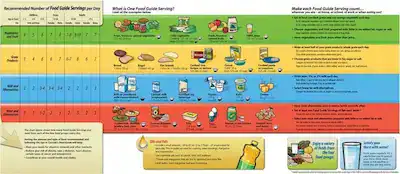
Adult guidelines promoted (adults aged 19-50 years):
- 5-10 7-8 (women) 8-10 (men) servings fruit & vegetables (at least 2 vegetables) – cooked, raw or fruit juices, include yellow or green or green leafy vegetables
- 5-12 6-7 (women) 8 (men) servings of Grain Products
- 2-4 2 (women and men) servings (skim, 2%, whole) milk, buttermilk or yogourt (serving = 1 cup milk, ¾ cup yogourt, 1 ½ oz cheese)
- 2-3 servings Meat and Alternates – (1 serving = 2-3 oz lean cooked meat, fish, or poultry, or 2 eggs, or ½ – 1 cup cooked legumes or 2 Tbsp. peanut butter)
Recommendations include:
Vegetables and Fruit
”go for orange vegetables such as carrots, sweet potatoes* and winter squash*“
*Note: starchy vegetables such as sweet potato and winter squash contain the SAME number of carbohydrates per serving as a serving of Breads and Cereals i.e., 15 g carbohydrate per ½ cup serving, compared with non-starchy vegetables such as asparagus, broccoli, and salad greens.
Under this Guide, Vegetables and Fruit can contribute 105 g — 150 g carbs per day (400 — 600 calories per day) if chosen as starchy vegetables and fruit/fruit juice.
Milk and Alternates
The Guide recommends: ”Drink skim, 1% or 2% milk each day” which overlooks the satiety (feeling fuller) effect of higher fat dairy.
”select lower fat milk alternates” — fails to look at the fact that loads of sugar as flavouring replaces the fat, contributing the equivalent of 2 — 4 servings of carbs per 3/4 cup serving (where a serving of carbs as per the Food Exchanges is considered 15 g carbohydrate per serving)
Oils and Fats
The Guide recommends: ”include a small amount (2-3 Tbsp.) of unsaturated fat each day. This includes oil for cooking, salad dressing, margarine, and mayonnaise. Use vegetable oils such as canola and soybean” resulting in the decrease of healthy-monounsaturated fats such as olive oil, nuts and seeds.
Children
The Guide recommends ”serve small nutritious meals and snacks daily.“
Three meals AND a few snacks?
Effect of Changes to Canada’s Food Guide on Obesity
What effect did these changes in dietary recommendations have on obesity statistics?
Children
- In 1978, only 15% of children and adolescents were overweight or obese.
- By 2007, that rate doubled to 29% of children and adolescents being overweight or obese.
- By 2011, obesity prevalence alone for boys was 15.1% and for girls was at 8.0% in 5 to 17-year-olds.
Adults
- The prevalence of obesity [body mass index (BMI) 30 kg/m2] in Canadian adults increased from 10% in 1970-72 to 26% in 2009-11
- Based on waist circumference, 37% of adults and 13% of youth are abdominally obese.
- Looking at these numbers slightly differently, as of 2013, there were approximately 7 million obese adults and 600 000 obese school-aged children in Canada
One has to wonder whether this dramatic increase in obesity and overweight after 1977 is correlated with Canada’s Food Guide shift to lower-fat, higher-carbohydrate diets.
Final Thoughts…
I give clients a choice of meal plan patterns because I don’t believe three meals and three snacks per day with 45-65% of calories as carbohydrate is the best way for people to address the matter of their excess weight.
More Info
If you would like more information, you can learn about me here.
To your good health!
Joy
You can follow me on:
Twitter: https://twitter.com/jyerdile
Facebook: https://www.facebook.com/BetterByDesignNutrition/
Copyright ©2015 BetterByDesign Nutrition Ltd.
LEGAL NOTICE: The contents of this blog, including text, images, and cited statistics, as well as all other material contained here (the ”content”), are for information purposes only. The content is not intended to be a substitute for professional advice, medical diagnosis, and/or treatment, and is not suitable for self-administration without the knowledge of your physician and regular monitoring by your physician. Do not disregard medical advice and always consult your physician with any questions you may have regarding a medical condition or before implementing anything you have read or heard in our content.

I am a Registered Dietitian Nutritionist and the owner of BetterByDesign Nutrition Ltd. With a postgraduate degree in Human Nutrition and a background as a published mental health nutrition researcher, I have been dedicated to supporting my clients’ clinical needs since 2008.
I hold active professional licenses in BC (CHPBC), Alberta (CDA), and Ontario (CDO), allowing me to provide regulated Medical Nutrition Therapy across these provinces. My expertise spans chronic disease management, complex digestive health, and therapeutic diets. I am deeply passionate about helping people reclaim their health, rooted in my firm belief that Nutrition is BetterByDesign©.