
Last clinically reviewed by Joy Y. Erdile, MSc, RD on April 23, 2026.
Introduction
The International Diabetes Federation has just released a new Position Statement that indicates that an oral glucose tolerance test performed at 1 hour is more effective in screening at-risk individuals for prediabetes and type 2 diabetes than a 2-hour Oral Glucose Tolerance Test (OGTT).
The International Diabetes Federation is a non-profit umbrella organization of more than 240 national diabetes associations from 161 countries, including the United States (represented by the American Diabetes Association), Canada, Australia, as well as many countries in Europe, Asia, and Africa. This global reach means that the IDF’s reports and recommendations have significant international implications.
This international Position Statement provides the evidence to support the practice of requisitioning a 1-hour post-load glucose test in place of a 2-hour Oral Glucose Tolerance Test to diagnose prediabetes and type 2 diabetes in at-risk individuals.
For physicians who prefer to choose to continue to order a 2-hour Oral Glucose Tolerance Test, this new Position Statement provides support for adding an assessor at 1 hour, something I have asked for over the last several years based on existing evidence.
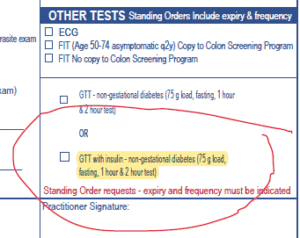
Adding an additional 1-hour glucose marker to the standard OGTT
Prediction of Risk of Type 2 Diabetes
The new Position Statement highlights that a 1-hour post-load plasma glucose level of 8.6 mmol/L (155 mg/dL) or higher in people with normal glucose tolerance strongly predicts the development of type 2 diabetes as well as various complications such as micro- and macrovascular issues, obstructive sleep apnea, metabolic dysfunction-associated fatty liver disease, and death in individuals with risk factors. The recommendations are for individuals with a 1-hour plasma glucose of 8.6 mmol/L (155 mg/dL) or higher to be prescribed lifestyle intervention and referred to a diabetes prevention program.
Diagnosis of Type 2 Diabetes
The Position Statement indicates that a 1-hour post-load plasma glucose level of 11.6 mmol/L (209 mg/dL) or higher confirms a diagnosis of type 2 diabetes and recommends that a repeat test be conducted to confirm the diagnosis of type 2 diabetes and, once confirmed, to refer the individual for treatment.
Benefits of the 1-hour Post-Load Glucose Test
The Position Statement indicates that the 1-hour post-glucose load test:
- shows glucose dysregulation earlier than the 2-hour post-glucose load test
- provides an opportunity to avoid misclassification of glucose status if fasting blood glucose or HbA1c is used alone
- predicts diabetes and associated complications, including death, in populations of different ethnicities, sex, and ages
- allows for early detection in high-risk individuals, which enables the ability to provide intervention to prevent progression to type 2 diabetes
Final Thoughts
The International Diabetes Federation Position Statement concludes that there is strong evidence to support redefining current diagnostic criteria for prediabetes and type 2 diabetes to include testing at 1-hour post-glucose during an Oral Glucose Tolerance Test.
Most significantly, the use of the 1-hour post-glucose load test allows for early detection and provision of dietary and lifestyle intervention support to prevent the progression to type 2 diabetes.
More Info
Requesting an extra assessor at 1-hour during a 2-hour Oral Glucose Tolerance Test is something I do under specific circumstances when I suspect one of my clients is progressing towards developing type 2 diabetes. Having those extra results showing them how high their blood sugar spikes at 1 hour often helps motivate and sustain change. Learn about me and the support I can provide you with through the Comprehensive Dietary Package.
To your good health,
Joy
You can follow me on:
Twitter: https://twitter.com/jyerdile
Facebook: https://www.facebook.com/BetterByDesignNutrition/
Quick Clinical Summary
Q: Why is a 1-hour OGTT better than a 2-hour test for diabetes screening?
A: The 1-hour post-load glucose test shows glucose dysregulation earlier than the 2-hour test and provides an opportunity to avoid misclassification of glucose status that can occur when using fasting blood glucose or HbA1c alone.
Q: What 1-hour glucose level predicts the risk of developing Type 2 Diabetes?
A: A 1-hour post-load plasma glucose level of 8.6 mmol/L (155 mg/dL) or higher strongly predicts the future development of type 2 diabetes and associated micro- and macrovascular complications.
Q: Can a 1-hour glucose test be used to diagnose Type 2 Diabetes?
A: Yes, a 1-hour post-load plasma glucose level of 11.6 mmol/L (209 mg/dL) or higher confirms a diagnosis of type 2 diabetes according to the International Diabetes Federation’s new Position Statement.
Reference
- Bergman, M., Manco, M., Satman, I., et al. (2024). International Diabetes Federation Position Statement on the 1-hour post-load plasma glucose for the diagnosis of intermediate hyperglycaemia and type 2 diabetes. Diabetes Research and Clinical Practice, 209, 111589. [https://www.diabetesresearchclinicalpractice.com/article/S0168-8227(24)00082-9/fulltext]

© 2025 BetterByDesign Nutrition Ltd.

I am a Registered Dietitian Nutritionist and the owner of BetterByDesign Nutrition Ltd. With a postgraduate degree in Human Nutrition and a background as a published mental health nutrition researcher, I have been dedicated to supporting my clients’ clinical needs since 2008.
I hold active professional licenses in BC (CHPBC), Alberta (CDA), and Ontario (CDO), allowing me to provide regulated Medical Nutrition Therapy across these provinces. My expertise spans chronic disease management, complex digestive health, and therapeutic diets. I am deeply passionate about helping people reclaim their health, rooted in my firm belief that Nutrition is BetterByDesign©.