
Introduction
According to the American Thyroid Association, 6% of the population have some type of thyroid disease and 60% of them (~12 million people) are unaware of it. Assuming the same rate applies in Canada, 2.3 million people in Canada have thyroid disease and almost 1.4 million people are unaware of it. Since changes in the skin may be one of the first clinical signs of hypothyroidism [2] and are often important indications of its progression [4], this article outlines how some of those skin changes may appear.
NOTE: This article also contains aspects of my personal story, which is why it is categorized as A Dietitian’s Journey. My personal experience is not objective data. The pictures are provided only so that people can better understand what some skin symptoms of hypothyroidism may look like. Many more pictures are available in clinical online.
My interest in hypothyroidism is more than academic, as I was recently diagnosed with it. I realize in retrospect that I missed almost all the early signs because I didn’t know what the range of possible symptoms could be. Just as my interest in hyperinsulinemia and type 2 diabetes was birthed in my own diagnosis and eventual partial remission, my interest in this hypothyroidism is no different. Since hypothyroidism can be dangerous if left untreated, my goal in writing this series of articles is to help people know the wide range of symptoms that may be associated with it, and to seek medical attention for themselves or their loved one, when necessary.
As outlined in the article Symptoms of Hypothyroidism Mistakenly Blamed on Aging, people think it is normal for ‘older adults’ to have body aches, joint pain, fatigue, to feel chilled when others do not, experience constipation, hair loss, be forgetful, or to experience depression. However, these are NOT typical signs of aging but ARE common symptoms of hypothyroidism.
Skin Symptoms Associated with Hypothyroidism
As mentioned in a previous article about the role of hormones in metabolic disease, thyroid hormones act on every organ system of the body, and their affect on the skin is no exception. Some skin symptoms such as myxedema don’t appear until much later in the progression of hypothyroidism, while other appear early on.
In this article, I will describe the later symptoms first because they are hallmarks of the progression of disease and indicate that getting medical attention is important. In my own case, it was the symptoms associated with myxedema that made me begin to realize that the tiredness and achy muscles and sore joints that I had been experiencing for over a year was more than post-Covid symptoms.
NOTE: these photos are for illustrative purposes only. Photos of myxedema in the clinical literature are available but are copyrighted. It is for this reason that I am posting my photos only as example, or illustrations.
Below is a photo showing the change in appearance in my left leg from November 3, 2021 (left), to July 16, 2022 (middle), to August 26, 2022 (right).
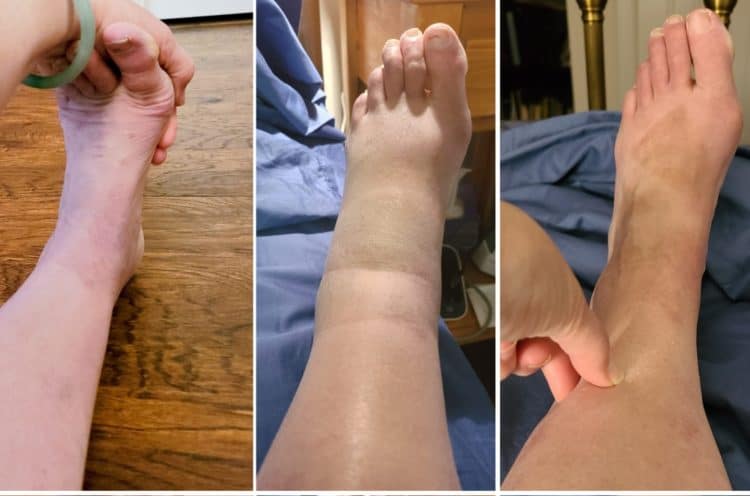
The photo on the left was taken by me last November while I was doing some stretches. It was still on my phone in mid-July when I took a picture of the swelling in my lower legs and ankles caused by mucin accumulating in the skin. The photo on the right was taken this morning, and while much of the swelling has been reduced, I am still unable to pinch any skin on my legs due to the remaining mucin. I have read that it can take 6 – 8 months for this to resolve.
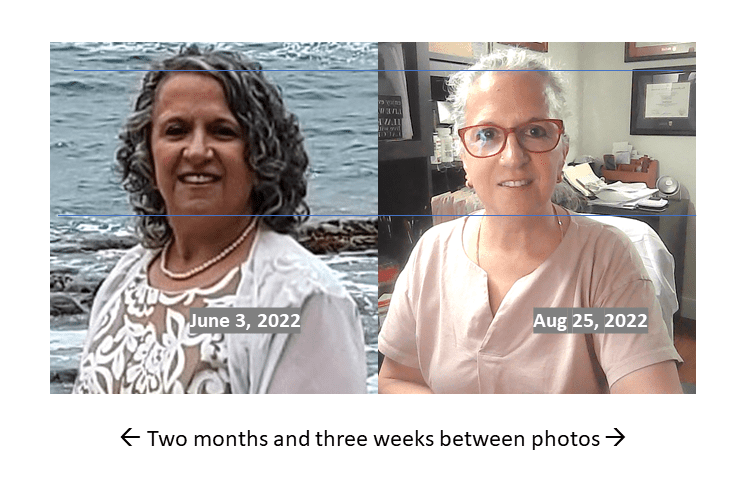
It has been only 2 months since I began treatment for hypothyroidism, beginning with a very low dose. The above photo shows what I looked like 2 ¾ months ago at my son’s wedding, and how quickly the myxedema in my face resolved with treatment.
What Causes the Skin Change Known as Myxedema
Myxedema is one several skin significant changes associated with the progression of hypothyroidism. A recently updated dermatology textbook describes myxedema as ‘skin that is cold and pale with abnormally widespread dryness (xerosis) and where a diffuse loss of hair (alopecia) may be present [5].’
When I first saw my doctor after my son’s wedding at the beginning of June, he pointed this out on my legs and said that the cold, waxy skin, along with the swelling, is a “benchmark symptom” of hypothyroidism. He showed me how it was impossible to pinch and lift any skin on my legs and that pressing on it left no ‘dent’ mark. This lack of a dent means the type of edema (swelling) is “non-pitting edema.” Pitting edema occurs in many other conditions, but this non-pitting edema, along with the cold, waxy skin, is characteristic of progressing hypothyroidism.
Other Skin Symptoms of Hypothyroidism
- Dry skin (xerosis)
- Thin scaly skin
- Carotinemia
- Purpura
- Telogen effluvium (hair loss)
- Decrease sweating
- Poor wound healing
Purpura is caused when small blood vessels burst, resulting in blood pooling just under the skin. It looks a bit like a bruise, but without pain or swelling and it does not change colour in time. Purpura is a non-serious skin hemorrhage that is almost always a symptom of something else and looks like small, reddish-purple spots just beneath the skin’s surface.
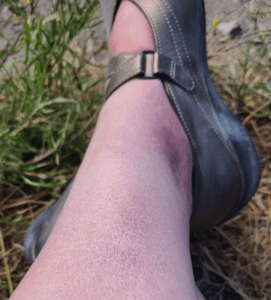
- August 20, 2022: purpura 75% resolved, thin dry skin, telogen effluvium (hair loss) yet to be resolved
How My Clinical Practice Is Impacted
Just as my clinical practice changed 5 years ago when I came to understand what hyperinsulinemia was, and how early clinical signs of developing type 2 diabetes are evident as long as 20 years before diagnosis, it is changing again as a result of what I am learning about hypothyroidism.
Final Thoughts…
The list of skin symptoms in hypothyroidism in this article is by no means exhaustive. If you think that you, or someone you know may have symptoms of hypothyroidism, please consult with a medical doctor.
To your good health!
Joy
You can follow me on:
Twitter/X: https://twitter.com/jyerdile
Facebook: https://www.facebook.com/BetterByDesignNutrition/
Quick Clinical Summary
Q: What is the difference between pitting and non-pitting edema in hypothyroidism?
A: Pitting edema leaves an indentation when pressed. Non-pitting edema, characteristic of hypothyroidism (myxedema), does not leave a dent because it is caused by the accumulation of mucin and water-binding hyaluronic acid in the dermis rather than simple fluid retention.
Q: How does hypothyroidism affect wound healing and sweating?
A: Hypothyroidism slows down metabolic processes across all organ systems. In the skin, this results in decreased activity of the sweat glands (leading to xerosis) and a significant slowing of the cellular repair processes necessary for proper wound healing.
Q: What is Purpura in the context of thyroid disease?
A: Purpura refers to small, reddish-purple spots caused by blood pooling beneath the skin’s surface. In hypothyroidism, it can occur due to increased capillary fragility and is often a sign of broader systemic hormonal imbalance.
References
- American Thyroid Association. Prevalence and Impact of Thyroid Disease. [Accessed August 26, 2022]. [https://www.thyroid.org/media-main/press-room/]
- Kasumagic-Halilovic E. Thyroid Disease and the Skin. Annals of Thyroid Research. 2014;1(2):27-31. [https://www.remedypublications.com/open-access/thyroid-disease-and-the-skin-654.pdf]
- Elshimy G, Chippa V, Correa R. Myxedema. [Updated 2022 May 22]. In: StatPearls [Internet]. Treasure Island (FL): StatPearls Publishing. [https://www.ncbi.nlm.nih.gov/books/NBK545193/]
- Medical News Today. What is Myxedema and How is it Treated? [Updated 2022 Apr 22]. [https://www.medicalnewstoday.com/articles/321886]
- Patterson JW. Weedon’s Skin Pathology. 5th edition. Elsevier Canada; 2020 Apr 20. [https://www.elsevier.com/books/weedons-skin-pathology/patterson/978-0-7020-7582-7]

© 2025 BetterByDesign Nutrition Ltd. All rights reserved.

I am a Registered Dietitian Nutritionist and the owner of BetterByDesign Nutrition Ltd. With a postgraduate degree in Human Nutrition and a background as a published mental health nutrition researcher, I have been dedicated to supporting my clients’ clinical needs since 2008.
I hold active professional licenses in BC (CHPBC), Alberta (CDA), and Ontario (CDO), allowing me to provide regulated Medical Nutrition Therapy across these provinces. My expertise spans chronic disease management, complex digestive health, and therapeutic diets. I am deeply passionate about helping people reclaim their health, rooted in my firm belief that Nutrition is BetterByDesign©.