
Lipoprotein(a), abbreviated Lp(a), is a particle related to LDL cholesterol that indicates an individual’s genetic risk of developing cardiovascular disease (CVD), or heart disease, and is >90% determined by a single inherited gene.
What is Lipoprotein(a)?
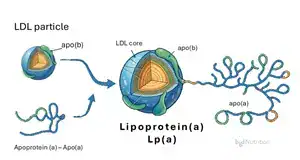
Lipoprotein(a), or Lp(a), is formed when the ApoB (apolipoprotein B) protein on an LDL cholesterol particle attaches to another protein called apolipoprotein(a)[1].
How is Lp(a) Linked to Heart Disease?
Genetic studies have found that variations in the LPA gene on chromosome 6 are what cause high levels of Lp(a), a major genetic risk factor for cardiovascular disease (CVD), also known as heart disease [2,3].
Can a Change in Diet or Exercise Improve Lipoprotein(a)?
No. Lipoprotein(a) is >90% genetically determined by the LPA gene [4], and as a result, dietary or lifestyle changes have little effect on Lp(a) levels.
People with high Lp(a) levels need to aggressively target dietary and lifestyle changes to lower LDL cholesterol and ApoB, as well as normalize blood pressure.
How Often Should Lipoprotein(a) be Tested?
An Lp(a) blood test only needs to be done once in an adult’s life [4] because Lp(a) levels are genetically determined and remain stable throughout a person’s life. Clinical guidelines do not recommend repeat testing for Lp(a); however, repeat testing of LDL cholesterol and ApoB should be done regularly to monitor the effect of dietary and lifestyle changes on these risk factors, which are significantly impacted by both diet and lifestyle.
What is the Evidence that Higher Lp(a) Increases the Risk of CVD?
The risk of ‘hardening of the arteries’, known as atherosclerotic cardiovascular disease (ASCVD), increases progressively as Lp(a) levels rise above 75 nmol/L (30 mg/dL)[4-6].
The Copenhagen Heart Study, which followed ~7500 people over 17 years, found that the risk of having a heart attack, known as a myocardial infarction (MI), rose in relation to Lp(a) levels as follows;
- individuals with Lp(a) levels between 75-125 nmol/L (30-76 mg/dl) had a 1.7-times higher risk (70% increase)
- those with levels >251 nmol/L (117 mg/dL) had a 2.7-times higher risk.[4]
The global INTERHEART study involving >6,000 first-time heart attack patients and >6,850 healthy controls across multiple ethnicities found the following;
- Lp(a) levels >125 nmol/L (50 mg/dL) were associated with a 48% higher risk of heart attack, and this risk was independent of other risk factors, including diabetes, high blood pressure, and smoking [7].
Are All Ethnicities Equally Affected By Higher Lp(a) Levels?
No. Lp(a) levels above 100 nmol/L (50 mg/dL) are found to affect ~20% of individuals of European or South Asian descent, ~40% of Black or African-Canadian or African-American descent, and <10% of people of East Asian descent [7,8].
Higher Lp(a) concentrations carry different risks for myocardial infarction in individuals of different ethnic backgrounds.
The population-attributable risk of Lp(a) >100 nmol/L (50 mg/dL) for myocardial infarction (MI), known as a heart attack, is as follows [7]:
- 9.5% in individuals of South Asian descent
- 8% in individuals of Latin American descent
- 5% in individuals of European descent
- <2% for individuals of East Asian descent
High Lp(a) levels also raise the risk of repeated cardiovascular events in a dose-dependent manner [7,9]
What Do Guidelines Say About Elevated Lipoprotein(a)?
The Canadian Cardiovascular Society (CCS) considers an Lp(a) ≥100 nmol/L (50 mg/dL) to be a significantly elevated risk [10], and a level of >175 nmol/L (70 mg/dl) is considered an extremely elevated risk in the current cardiovascular literature [11,12].
The CCS guidelines recommend that individuals with an Lp(a) level of 100 nmol/L or higher receive earlier and more intensive health behavior modification counseling to lower modifiable atherosclerotic cardiovascular disease (ASCVD) risk factors, including elevated cholesterol and high blood pressure [10]. Since dietary changes and exercise do not lower Lp(a) directly, dietary interventions focus on lowering overall cardiovascular baseline risk by aggressively targeting LDL cholesterol (aiming for <1.8 mmol/L), ApoB (aiming for <0.70 g/L), and blood pressure (aiming for systolic <130mm/Hg) [10].
Do Statins Lower Lp(a)?
No. Medications such as statins and ezetimibe have very little effect on Lp(a) levels [10]. Lipid-lowering therapies that have been reported to lower Lp(a) include PCSK9 inhibitors, niacin, and apheresis; but there is limited evidence for their use in patients with a high Lp(a) level [10].
Clinical Application
When individuals come to me with current lab results indicating very high cholesterol levels, especially high LDL cholesterol, and high ApoB, along with a familial history of heart disease, I will request that an Lp(a) test be done to determine their risk of cardiovascular disease.
Lp(a) testing is available across Canada and is covered by public health insurance in most provinces, except Ontario and Manitoba [10].
Final Thoughts
If a person’s Lp(a) results are >100 nmol/L, I will explain the significantly elevated risk and, if >175 nmol/L, the extremely elevated risk of cardiovascular disease, and also explain how their ethnicity may elevate that risk.
I will also explain that designing their Meal Plan will require an extra hour’s work to factor in current clinical guidelines to aggressively target lowering LDL cholesterol, ApoB, and blood pressure, within the clinical information that I will or have already collected during the assessment visit.
More Info
If you have a family history of high cholesterol and/or cardiovascular disease, I can design a Meal Plan to help lower your risk. You can learn about me here and the Comprehensive Dietary Package that I offer.
If you have high or very high Lp(a) levels, I can design a Meal Plan to aggressively target modifiable risk factors based on current clinical guidelines, and the Comprehensive Dietary Package with complex clinical add-on is the package to look at.
To your good health,
Joy
You can follow me on:
Twitter: https://twitter.com/jyerdile
Facebook: https://www.facebook.com/BetterByDesignNutrition/
Quick Clinical Summary
Q: Is Lp(a) linked to heart disease?
A: Yes, variations in the LPA gene on chromosome 6 cause high levels of Lp(a), which is a major genetic risk factor for cardiovascular disease (CVD).
Q: Can dietary changes lower Lp(a) levels?
A: No. Lipoprotein(a) is >90% genetically determined by the LPA gene on chromosome 6 [4], and as a result, dietary or lifestyle changes have little effect on Lp(a) levels.
Q: Do certain races have greater risk with high Lp(a) levels?
A: Yes, the population-attributable risk of heart attack (myocardial infarction) of Lp(a) >100 nmol/L (50 mg/dL) is 9.5% in people of South Asian descent, 8% in those of Latin American descent, 5% in people of European descent, and <2% for individuals of East Asian descent.
References
- Witztum JL, Ginsberg HN. Lipoprotein (a): Coming of Age at Last. J Lipid Res. 2016 Mar;57(3):336-9. doi: 10.1194/jlr.E066985. Epub 2016 Feb 2. PMID: 26839334; PMCID: PMC4766984.
- Clarke R, Peden JF, Hopewell JC, et al. Genetic variants associated with Lp(a)lipoprotein level and coronary disease. N Engl J Med 2009;361:2518–28.
- Kamstrup PR, Tybjaerg-Hansen A, Steffensen R, Nordestgaard BG. Genetically elevated lipoprotein(a) and increased risk of myocardial infarction. JAMA 2009;301:2331–9.
- Langsted A, Kamstrup PR, Nordestgaard BG. Lipoprotein(a): fasting and nonfasting levels, inflammation, and cardiovascular risk. Atherosclerosis 2014;234:95–101.
- Erqou S, Kaptoge S, et al. Emerging Risk Factors Collaboration – Lipoprotein (a) concentration and the risk of coronary heart disease, stroke, and nonvascular mortality. JAMA 2009;302:412–23.
- Madsen CM, Kamstrup PR, Langsted A, Varbo A, Nordestgaard BG. Lipoprotein(a)-lowering by 50 mg/dL (105 nmol/L) may be needed to reduce cardiovascular disease 20% in secondary prevention: a population-based study. Arterioscler Thromb Vasc Biol 2020;40:255–66.
- Pare G, Caku A, McQueen M, et al. Lipoprotein(a) levels and the risk of myocardial infarction among 7 ethnic groups. Circulation 2019;139:1472–82.
- Enkhmaa B, Anuurad E, Berglund L. Lipoprotein (a): impact by ethnicity and environmental and medical conditions. J Lipid Res 2016;57:1111–25.
- O’Donoghue ML, Fazio S, Giugliano RP, et al. Lipoprotein(a), PCSK9 inhibition, and cardiovascular risk. Circulation 2019;139:1483–92.
- Pearson, G. J., Thanassoulis, G., Anderson, et al. (2021). 2021 Canadian Cardiovascular Society Guidelines for the Management of Dyslipidemia for the Prevention of Cardiovascular Disease in the Adult. Canadian Journal of Cardiology, 37(8), 1129–1150.
- Patel, A. P., et al. (2020). Lp(a) (Lipoprotein[a]) Concentrations and Incident Atherosclerotic Cardiovascular Disease: New Insights From a Large Prospective Cohort Study. Arteriosclerosis, Thrombosis, and Vascular Biology, 41(1), 465–474.
- Razavi, A. C. Precise versus pragmatic – a perspective and evaluation of Lipoprotein(a) testing recommendations: A fellow’s voice, American Journal of Preventive Cardiology, Volume 17, 2024, 100637.


I am a Registered Dietitian Nutritionist and the owner of BetterByDesign Nutrition Ltd. With a postgraduate degree in Human Nutrition and a background as a published mental health nutrition researcher, I have been dedicated to supporting my clients’ clinical needs since 2008.
I hold active professional licenses in BC (CHPBC), Alberta (CDA), and Ontario (CDO), allowing me to provide regulated Medical Nutrition Therapy across these provinces. My expertise spans chronic disease management, complex digestive health, and therapeutic diets. I am deeply passionate about helping people reclaim their health, rooted in my firm belief that Nutrition is BetterByDesign©.