
INTRODUCTION

Almost everyone in the nutrition world is talking about the new Dietary Guidelines for Americans that were released on January 7, 2026, and how the US Food Pyramid has finally been turned on its head. As a Canadian Registered Dietitian who has been writing for more than a decade about the effects of Canada’s Food Guide on rates of adult and child overweight and obesity, I have watched Canada follow the US’s lead with devastating consequences. Last week, things changed.
The new Dietary Guidelines for America (DGA) prioritizes highly bioavailable animal protein and healthy sources of fat while minimizing dietary intake of carbohydrates, even “healthy whole grains“. Along with the new Guidelines, the US government also released a 90-page Scientific Report on which the new Dietary Guidelines were based, and a 418-page document with appendices to the Scientific Report.
Meanwhile, Canadians are left to follow the recommendations of the 7-year-old 2019 Canada Food Guide that encourages dietary intake of protein “especially from plant-based sources“, and a high-carbohydrate dietary pattern, which is continuing to have health implications for Canadians. It is long overdue for Health Canada to examine the current scientific evidence and release a 2026 Canada’s Food Guide based on a new foundation.
This article documents some of the changes in Canada’s Food Guide that began in 1977, and the corresponding increase in both adult and childhood obesity that has followed, right up until an October 2025 report from Statistics Canada. As was the case in the US, the last ~50 years have effectively been a high-carbohydrate epidemiological experiment predicated on misrepresentation and sustained by political inertia.
For the health of Canadian children and adults, it is time that this changes.
The Corrupt Foundation
In September 2016, the Journal of the American Medical Association revealed that in the mid-1960s, the sugar industry had funded three renowned Harvard researchers to write a series of articles that downplayed or ignored known research that demonstrated that sugar was a contributor to heart disease and put the blame solely on fat, especially saturated fat [1].
I first wrote about this on March 12, 2018 [2], but what I didn’t mention at the time was that when I realized that what I was taught throughout my undergraduate degree (and subsequently taught others) was predicated on a lie and rooted in corruption, I considered leaving my profession as a Registered Dietitian.
Project 226
In 1965, the Sugar Research Foundation (SRF), predecessor to the Sugar Association, sought to counter research that was known at the time and to suggest that sugar, not fat, was the bigger contributor to atherosclerosis and heart disease.
The Sugar Research Foundation’s committee invited Dr. Frederick Stare, Chair of the prestigious Harvard School of Public Health Nutrition Department, to join its scientific advisory board, and approved $6,500 ($65,750–$66,850 in 2025 dollars) “to support a review article that would respond to the research showing the danger of sucrose [1]”. Joining Dr. Stare on the project were two other Harvard researchers: Dr. Robert McGandy, Assistant Professor of Nutrition at the Harvard School of Public Health, and Dr. D. Mark Hegsted, Professor of Nutrition at the Harvard School of Public Health.
Project 226, as it became known, resulted in a two-part review by McGandy, Hegsted, and Stare that was published in the New England Journal of Medicine in 1967 titled “Dietary Fats, Carbohydrates and Atherosclerotic Disease” [3]. There was no mention of the Sugar Research Federation sponsorship of the research [1].
In the publication, Dr. Hegsted stated that there was “a clear linkage” between plasma fat and heart disease – and this was based on only 8 randomized clinical trials that were available at the time, and which had only 2,467 male subjects, and no female subjects [4]. Furthermore, there was no clinical evidence that reducing total fat or saturated fat lowered death from all causes or cardiovascular disease [4].
Eight hearings of the Committee titled “Diet Related to Killer Diseases” were held from July 1976 until October 1977 [6], which provided an opportunity for US senators to hear from leading scientists, government officials, and business representatives about the risks of diet on heart disease, cancer, and other chronic diseases. Several researchers pleaded with the Committee to wait for more research. The director of the National Heart, Lung, and Blood Institute, Dr. Robert Levy, said, “no one knew if eating less fat would prevent heart attacks “[4], and Dr. Peter Ahrens said,
“advising Americans to eat less fat on the strength of such marginal evidence was equivalent to conducting a nutritional experiment with the American public as subjects“[4].
Indeed, this is exactly what occurred – not only in the United States, but as documented below, in Canada as well.
Dr. Hegsted’s Role in the 1977 Dietary Guidelines for Americans
After writing the Sugar Industry-sponsored articles blaming fat for cardiovascular disease, Dr. Hegsted went on to play a significant role in advising the Select Committee on Nutrition and Human Needs that oversaw the development of the 1977 Dietary Goals for the United States.
He also oversaw the writing of the first Dietary Guidelines for Americans, which called for a reduction in saturated fat consumption to lower the risk of coronary heart disease [5][6].
Dr. Hegsted’s influence and the effect of his recommendations were not limited to the American public, as the 1977 Canada’s Food Guide made the same low-fat dietary recommendations
1977 Canada Food Guide – mirroring US recommendations
Advising the public to eat less fat on the strength of marginal evidence was equivalent to conducting an epidemiological experiment with both the American and Canadian public as subjects. As I wrote more than a decade ago, in an article titled “Canada’s Food Guide — an Epidemiological Experiment Gone Wrong” [7];
“Beginning in 1977, and in ever increasing amounts, Health Canada has shifted their recommendations away from healthy fats and low-carbohydrate diets, towards diets where carbohydrates form the main source of calories. Current recommendations are for 45-65% of calories to come from carbohydrates and only 20- 30% of calories from fat. In ever increasing amounts, Health Canada has recommended that we avoid fat and eat 1/2 to 2/3 of our calories from carbohydrates.
How has Canada’s obesity rate changed since then?
In 1978, only 15% of children and adolescents were overweight or obese. By 2007, 29% of children and adolescents were overweight or obese. By 2011, the obesity prevalence alone for boys was 15.1% and for girls was 8.0% in 5- to 17-year-olds.
What about adults? From 10% in 1970-72 to 26% in 2009-2010, the prevalence of obesity [body mass index (BMI) ≥30 kg/m2] in Canadian adults increased two and a half times. In 1970-72, 7.6% of men and 11.7% of women were considered obese. In 2013, 20.1% of men and 17.4% of women were considered obese. And looking at waist circumference, 37% of adults and 13% of youth are currently considered abdominally obese.
So, how have Health Canada’s recommendations of a high carbohydrate low fat diet been working out? It seems to me like an epidemiological experiment gone wrong.”
Forty Years After the 1977 Canada’s Food Guide
Two years later, on May 11, 2017, I posted an article titled “1977 Dietary Recommendations — forty years on” [8], where I updated overweight and obesity data in both children and adults, and correlated them with the change in dietary recommendations since 1977 [8].
“The US recommendations since 1977 have been similar to those in Canada, with the Dietary Goals for the United States recommending that carbohydrates are 55-60% of daily calories and that calories from fat be no more than 30% of daily calories (of which no more than 1/3 comes from saturated fat).”
Currently, we are using Eating Well with Canada’s Food Guide, which came out in 2007, and which recommends that people eat even more of their daily calories as carbohydrates.
- 45-65% of daily calories as carbohydrate
- 20-35% of daily calories as fat, with no more than 1/3 from saturated fat
- 10-35% of daily calories as protein
What has been the outcome of people following these dietary recommendations to eat a high-carb diet since 1977?
In 1977, obesity rates* were 7.6% for men and 11.7% for women, with the combined rate of < 10 % for both genders.* Obesity is defined as a Body Mass Index (BMI) 30 kg/(m)2
In 1970-72, the obesity rate in Canadian adults was 10%, and by 2009-2011, it increased two and a half times, to 26%.
In 1970-72, only 7.6% of men were obese, but by 2013, 20.1% of men were categorized as obese. In 1970-72, only 11.7% of women were obese but by 2013, 17.4% of women were obese.
In 1978 in Canada, only 15% of children and adolescents were overweight or obese, yet by 2007, that prevalence almost DOUBLED to 29% of children and adolescents being overweight or obese. By 2011, obesity prevalence alone (excluding overweight prevalence) for boys aged 5- to 17 years was 15.1% and for girls was 8.0%.
Since 1977, the emphasis on consuming diets high in carbohydrates and low in fat has taken its toll.”
Before the 2019 Canada’s Food Guide was released, I had sincerely hoped that dietary recommendations would change. They did, but not in a way that slowed the rise of both overweight and obesity.
2019 Canada Food Guide
In January 2019, I wrote a series of articles about the then “new” Canada Food Guide, which is still the current one, seven years later. The first of these articles outlined Health Canada’s dietary recommendations for Canadians in 2026 [8].
A pre-release article outlined how the 2019 Canada Food Guide has only 3 Food Groups: (1) Vegetables and Fruit, (2) Whole Grains, and (3) Protein Foods — having dropped both the “Meat and Alternatives” and “Milk and Alternatives” food groups. Eliminating these two food groups dropped prior recommendations for adults and children to consume 2-3 servings of Meat and Alternatives and Milk and Alternatives each day [9].
Given that since 2017, Health Canada had been posting on its website its “Guiding Principles, Recommendations and Considerations,” which included Guiding Principle 1.
“Regular intake of vegetables, fruit, whole grains, and protein-rich foods* — especially plant-based sources of protein
Inclusion of foods that contain mostly unsaturated fat, instead of foods that contain mostly of saturated fat.”
The 2019 Canada’s Food Guide recommended that Canadians “especially choose plant-based sources of protein,” which ignores that most plant-based proteins are not equivalent in terms of bioavailable protein to animal-based protein.
As outlined in this article, written on August 20, 2023, and updated on November 2, 2025, a recent study found that essential amino acids from animal protein are more bioavailable than those from plant protein [10]. This is significant because essential amino acids must be consumed in the diet since the body can’t make them. But what is “bioavailability”?
Amino Acids and Bioavailability
Bioavailability refers to the degree to which essential amino acids in food can be used by the body to build its own proteins [11], such as muscle tissue.
For example, leucine is an essential amino acid that plays a key role in muscle growth and repair by triggering mTOR signaling in muscle cells, which stimulates protein synthesis [12]. Obtaining sufficient leucine in the diet is especially important for older adults who need to preserve muscle mass (i.e., avoid sarcopenia), as well as for active adults who want to build or repair muscle.
Plant proteins generally contain lower levels of leucine than animal proteins [13], therefore the implications of the 2019 Canada’s Food Guide’s protein recommendations cannot be overlooked.
Dietary recommendations for older adults emphasize obtaining about 2.3 g of leucine per meal to support muscle growth [14] and approximately 3 g of leucine per meal to rebuild muscle after exercise [15]. Recent research suggests a practical target range of 2.5–3.0 g of leucine per main meal, roughly equivalent to 25–30 g of high-quality protein. This level best supports muscle protein synthesis in older adults and enhances recovery when paired with light resistance exercise.
The problem is that most legumes (“beans” and lentils), except soybeans, are incomplete proteins, meaning they lack one or more essential amino acids. For example:
- Lentils contain about 0.7 g of leucine per half cup.
- Chickpeas contain about 0.42 g of leucine per half cup.
The 2019 Canada’s Food Guide emphasizes eating plant-based proteins, and to get sufficient leucine, older adults would need to eat more than 3 cups of lentils or 5½ cups of chickpeas at one meal to reach the 2.3 g leucine threshold needed to trigger muscle protein synthesis.
Emphasizing a plant-based protein intake may be putting older Canadians at risk of accelerated rates of sarcopenia (muscle loss) as they age due to decreased availability of the essential amino acid, leucine.
Current Rates of Overweight and Obesity in Canada
A newly released report (October 2, 2025) from Statistics Canada titled “The prevalence of overweight and obesity is on the rise in Canada: New results from the Canadian Health Measures Survey, 2022 to 2024” [16] indicates that:
- More than two-thirds (68%) of Canadian adults (aged 18 to 79 ) were classified as overweight or obese during the period 2022 to 2024
- This represents an 8% increase from before the COVID-19 pandemic (2016 to 2019), where 60% of Canadian adults were overweight or obese
- Half of Canadian adults (49%) had a waist circumference above Canadian thresholds. Abdominal obesity, which is excessive fat stored around the waist and stomach area, is associated with increased health risks.
- nearly one in three Canadians (31%) aged 5 to 17 were classified as overweight or obese. While this proportion has not changed significantly over time, it remains a concern due to long-term health risks associated with excess weight in childhood.
Continuing to advise Canadians to eat a low-fat, largely carbohydrate-based diet continues to be “an epidemiological experiment gone wrong”.
American scientists have reexamined the literature and are making different dietary recommendations, reflected in their recently released Dietary Guidelines for Americans, 2025-2030 [17][18][19].
The New Upside-Down US Food Pyramid
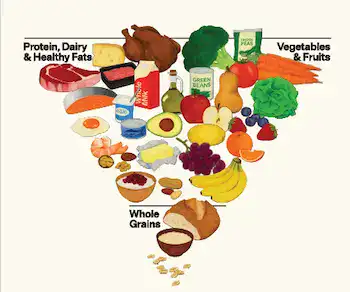
Last week, on January 7, 2026, the US released its new Dietary Guidelines for America, which literally turned the US Food Pyramid upside down!
These Guidelines are contained in the 10-page pdf titled Dietary Guidelines for Americans 2025-2023 [17], and summarized below.
- Prioritize high-quality, nutrient-dense protein foods as part of a healthy dietary pattern.
- Consume a variety of protein foods from animal sources, including eggs, poultry, seafood, and red meat, as well as a variety of plant-sourced protein foods, including beans, peas, lentils, legumes, nuts, seeds, and soy.
- Protein serving goals: 1.2–1.6 grams of protein per kilogram of body weight per day, adjusting as needed based on your individual caloric requirements. [Note: this is almost double the Canadian protein recommendations].
- When consuming dairy, include full-fat dairy, with no added sugars. Dairy is an excellent source of protein, healthy fats, vitamins, and minerals. Dairy serving goals: 3 servings per day as part of a 2,000-calorie dietary pattern, adjusting as needed based on your individual caloric requirements.
- Healthy fats are plentiful in many whole foods, such as meats, poultry, eggs, omega-3–rich seafood, nuts, seeds, full-fat dairy, olives, and avocados. In general, saturated fat consumption should not exceed 10% of total daily calories. Significantly limiting highly processed foods will help meet this goal. More high-quality research is needed to determine which types of dietary fats best support long-term health.
- Significantly reduce the consumption of highly processed, refined carbohydrates, such as white bread, ready-to-eat or packaged breakfast options, flour tortillas, and crackers.
- Prioritize fiber-rich whole grains. Whole grains serving goals: 2–4 servings per day, adjusting as needed based on your individual caloric requirements.
- Avoid highly processed packaged, prepared, ready-to-eat foods
- Avoid sugar-sweetened beverages, such as sodas, fruit drinks, and energy drinks
- No amount of added sugars or non-nutritive sweeteners is recommended or considered part of a healthy or nutritious diet; one meal should contain no more than 10 grams of added sugars.
- Consume less alcohol for better overall health.
- Sodium and electrolytes are essential for hydration. The general population, ages 14 and above, should consume less than 2,300 mg per day of sodium. Highly active individuals may benefit from increased sodium intake to offset sweat losses.
The new Dietary Guidelines for Americans are based on the 90-page Scientific Report of the 2025 Dietary Guidelines Advisory Committee (DGAC Report) [19] and the appendices alone to this report are contained in a 418-page document, The Scientific Foundation for the Dietary Guidelines for Americans Appendices [20]. There is robust scientific evidence for the new Dietary Guidelines for Americans.
Canada’s Dietary Recommendations are Seven Years Old
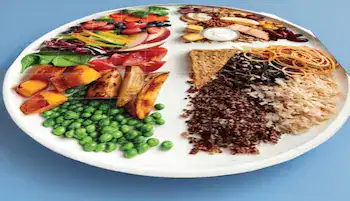
Canadians’ “current” dietary recommendations are the seven-year-old 2019 Canada Food Guide, which recommends that ¼ of the average meal contain grain. Based on a 2000 kcal/day diet, that’s 500 calories per day / ~125 g of carbohydrate from the grain group alone [20].
Add in the carbohydrate from the largely plant-based protein group, there’s perhaps another ~100 g carbohydrate per day, on average [20].
Given that half the plate should be vegetables and fruit, and both fruit and starchy vegetables such as squash, yam, potato, peas and corn contain 15 g of carbohydrate per half cup, and assuming that half of those servings will be a mixture of starchy vegetables and fruit, and the remaining vegetables will be non-starchy (5 g of carbs per ½ cup serving), the vegetable and fruit 1/4 of the average meal plate adds another ~125 g of carbohydrate per day to the diet [20].
The recommended sample plate provides Canadian adults with ~300 g of carbohydrate per meal.
For the health of Canadian children and adults, it’s overdue for Health Canada to review the current scientific evidence and release a 2026 Canada’s Food Guide.
Final Thoughts…
Tensions between Canada and the US are at an all-time high, but Canadians do not have to like US politics or leaders to respect the science.
The 2026 Dietary Guidelines for Americans is the first time in ~50 years that the US government has allowed peer-reviewed epidemiological evidence to override the sugar-funded epidemiological experiment of 1977. While the names in Washington have changed, human metabolism has not.
Rates of overweight and obesity continue to climb, and Canadians need a new 2026 Canada’s Food Guide that reflects current science.
More Info
You can learn about me here, and the range of routine health, digestive health, and therapeutic diets that I provide here.
To your good health.
Joy
You can follow me on:
Twitter: https://twitter.com/jyerdile
Facebook: https://www.facebook.com/BetterByDesignNutrition/
References
- Kearns C, Schmidt LA, Glantz SA, et al. Sugar Industry and Coronary Heart Disease Research: A Historical Analysis of Internal Industry Documents. JAMA Intern Med. 2016;176(11):1680-1685. [https://pubmed.ncbi.nlm.nih.gov/27617709/]
- Erdile (Kiddie), J. Sugar Industry Paid to Shift Blame for Heart Disease to Fat, Food for Thought (articles), March 12, 2018 (updated Nov. 24, 2025), BetterByDesign Nutrition, Sugar Industry Paid to Shift Blame for Heart Disease to Fat
- McGandy RB, Hegsted DM, Stare FJ. Dietary fats, carbohydrates and atherosclerotic vascular disease. N Engl J Med. 1967;277(5): part 1: pg. 186-192 and part 2: pg. 242–247. [part 1: https://www.nejm.org/doi/10.1056/NEJM196708032770505], [part 2: https://www.nejm.org/doi/abs/10.1056/NEJM196707272770405]
- Harcombe Z. An examination of the randomized controlled trial and epidemiological evidence for the introduction of dietary fat recommendations in 1977 and 1983. 2015. [https://pubmed.ncbi.nlm.nih.gov/25685363/]
- Dietary Goals for the United States, Select Committee on Nutrition and Human Needs, United States Senate. Washington: U.S. Govt. Print. Off., 1977. [https://www.govinfo.gov/content/pkg/CPRT-95SPRT98364O/pdf/CPRT-95SPRT98364O.pdf]
- Oppenheimer GM, Benrubi ID. McGovern’s Senate Select Committee on Nutrition and Human Needs versus the meat industry on the diet-heart question (1976-1977). Am J Public Health. 2014;104(1):59–69.
- Erdile (Kiddie), J., “Canada’s Food Guide — an Epidemiological Experiment Gone Wrong?” Food for Thought (archive articles), March 25, 2015, BetterByDesign Nutrition, Canada’s Food Guide — an Epidemiological Experiment Gone Wrong?
- Erdile (Kiddie), J. “1977 Dietary Recommendations — forty years on”, Food for Thought (archive articles), May 11, 2017, BetterByDesign Nutrition, 1977 Dietary Recommendations — forty years on
- The Globe and Mail, Ann Hui, Canada’s Food Guide poised to shift focus from meat, dairy to vegetables, protein, published January 8, 2019, https://www.theglobeandmail.com/canada/article-new-draft-of-canadian-nutrition-guide-drops-to-three-food-groups/
- Connolly, G., Hudson, J. L., Bergia, R. E., et al. (2023). Effects of Consuming Ounce-Equivalent Portions of Animal- vs. Plant-Based Protein Foods, as Defined by the Dietary Guidelines for Americans, on Essential Amino Acid Bioavailability in Young and Older Adults: Two Cross-Over Randomized Controlled Trials. Nutrients, 15(13), 2870. [https://doi.org/10.3390/nu15132870]
- Gaudichon, C., & Calvez, J. (2021). Determinants of Amino Acid Bioavailability from Ingested Protein in Relation to Gut Health. Curr Opin Clin Nutr Metab Care, 24(1), 55-61. [https://pubmed.ncbi.nlm.nih.gov/33093304/]
- Norton, L. E., & Layman, D. K. (2006). Leucine Regulates Translation Initiation of Protein Synthesis in Skeletal Muscle after Exercise. J Nutr, 136(2 Suppl), 533S–537S.
- Berrazaga, I., Micard, V., Gueugneau, M., & Walrand, S. (2019). The Role of the Anabolic Properties of Plant- versus Animal-Based Protein Sources in Supporting Muscle Mass Maintenance: A Critical Review. Nutrients, 11(8), 1825. [https://pubmed.ncbi.nlm.nih.gov/31394788/]
- Bauer, J., Biolo, G., Cederholm, T., et al. (2013). Evidence-Based Recommendations for Optimal Dietary Protein Intake in Older People: A Position Paper from the PROT-AGE Study Group. J Am Med Dir Assoc, 14(8), 542–59. [https://pubmed.ncbi.nlm.nih.gov/23867520/]
- Thomas, D. T., Erdman, K. A., & Burke, L. M. (2016). American College of Sports Medicine Joint Position Statement: Nutrition and Athletic Performance. Med Sci Sports Exerc, 48(3), 543–568. [https://pubmed.ncbi.nlm.nih.gov/26891166/]
- Statistics Canada, The prevalence of overweight and obesity is on the rise in Canada: New results from the Canadian Health Measures Survey, 2022 to 2024, Released: 2025-10-02, https://www150.statcan.gc.ca/n1/daily-quotidien/251002/dq251002b-eng.htm
- Dietary Guidelines for Americans, 2025-2030, 10 pages, https://cdn.realfood.gov/DGA.pdf
- Scientific Foundation for the Dietary Guidelines for Americans, Scientific Report of the 2025 Dietary Guidelines Advisory Committee (DGAC Report), 90 pages, https://cdn.realfood.gov/Scientific%20Report_1.8.26.pdf
- The Scientific Foundation For The Dietary Guidelines For Americans Appendices, Appendices to the Scientific Report of the 2025 Dietary Guidelines Advisory Committee (DGAC Report, 418 pages, https://cdn.realfood.gov/Scientific%20Report%20Appendices_1.8.26.pdf
- Erdile (Kiddie), J. “New Canada Food Guide – carbohydrate estimate of the sample plate”, Food for Thought (archive articles), January 24, 2019, BetterByDesign Nutrition, https://bbdnutrition.com/2019/01/24/new-canada-food-guide-carbohydrate-estimate-of-the-sample-plate/


Joy is a Registered Dietitian Nutritionist and owner of BetterByDesign Nutrition Ltd. She has a postgraduate degree in Human Nutrition, is a published mental health nutrition researcher, and has been supporting clients’ needs since 2008. Joy is licensed in BC, Alberta, and Ontario, and her areas of expertise range from routine health, chronic disease management, and digestive health to therapeutic diets. Joy is passionate about helping people feel better and believes that Nutrition is BetterByDesign©.