
Note: This article was originally posted on August 13, 2023, and was updated on September 3, 2026.
Practitioner’s Preface
This morning, I saw a social media post in which a naturopath challenged a wellness podcast producer’s claim that blending fruit quadruples its glycemic profile. In the video, podcast producer Gary Brecka is heard saying;
“I don’t blend fruits because you’ll quadruple the glycemic profile. I mean the difference between a banana that you eat and a banana you put in the blender is night and day…because you disperse the fiber that’s in the fruit. You’re basically quadrupling its impact on blood sugar, the rate, the glycemic index, which is the rate at which blood sugar rises.”
The naturopath’s objection was:
“Why do so many people make claims without actually researching the topic? What he’s saying just isn’t true. Blending fruits either has little impact or can even reduce the glycemic index.“
How can they both be right?
- The naturopath is correct that blending fruit has little impact on the Glycemic Index.
- Gary Brecka is also correct that blended fruit quadruples its glycemic profile.
I am guessing that Brecka may have misspoken when he said ‘glycemic index ‘ and may have meant to say ‘glycemic load‘. As outlined below, blending fruit does significantly increase its glycemic profile.
What is the Difference Between Glycemic Index and Glycemic Load?
Glycemic Index and Glycemic Load are very different measurements. Two foods can both have a high Glycemic Index (GI), but have very different impacts on blood sugar, which is Glycemic Load (GL).
- Glycemic Index (GI) is determined by comparing how healthy people’s blood sugar responds over two hours to a food containing 50 grams of digestible carbohydrate from that food compared to 50 grams of glucose (pure sugar).
- Glycemic Load (GL) indicates how a healthy person’s body will respond to the carbohydrate in one serving of a food.
Watermelon and a Medium Glazed Donut Have the Same Glycemic Index

Watermelon and a medium glazed donut have almost the same high Glycemic Index (GI) value ~ 72–76); however, their impact on blood sugar is very different when accounting for portion size, which is Glycemic Load (GL)
As I wrote in an article posted in April 2018, watermelon and a medium glazed donut both have a high Glycemic Index between 72–76. One serving of watermelon (1/2 a cup, 150g) has ~11-12 g of carbohydrate, whereas one medium doughnut (one serving, ~60 g) has ~31-35 g of carbs.
- The Glycemic Load of watermelon is ~5-8, which is low
- The Glycemic Load of a medium glazed donut is ~17-20, which is high
Two foods can have the same Glycemic Index and have very different effects on blood sugar.
Do Smoothies Really Quadruple the Glycemic Index?
No. We know from the research that the Glycemic Index of 60g of a whole apple, 60 g of pureed apple, and 60g of juiced apple are very similar [1]; so making a smoothie out of an apple does not change its Glycemic Index.
As I wrote about on June 8, 2018, in an article titled The Perils of Food Processing (Part 1), and as can be seen in the graph below, the blood glucose response 90 minutes later from consuming 60 g of a whole apple, 60 g of pureed apple, and 60g of juiced apple is significantly different. This difference is due to the effect on blood sugar due to the disruption of dietary fiber [2].
Glycemic Index tells us how quickly a food raises blood sugar, not how high blood sugar will go.
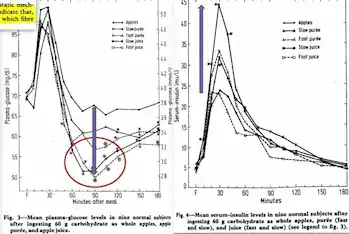
Recent research emphasizes that food structure, not just carbohydrate content, plays a critical role in blood glucose control [2].
Cellular carbohydrates come from whole, intact foods where the carbohydrate is still inside the cell wall. These foods take longer to digest and be absorbed into the bloodstream than ground or pureed foods.
Carbohydrates that have been pureed, like fruit in a smoothie, or ground, like flour made from grain, are now outside their cell wall (acellular carbohydrate). As a result, pureed and ground foods are digested more quickly because the fiber that normally slows absorption is disrupted.
A Smoothie as “Pre-Chewed” Food

Most people think digestion begins in the stomach, but it starts in the mouth, when we chew food. As unappealing as it sounds, smoothies are “pre-chewed” food.
Drinking carbohydrates, rather than eating them, can cause a significant blood sugar spike and also result in hunger that can follow a quick rise and fall in blood sugar, resulting from the insulin response.
Research shows that when the same fruit is pureed or juiced, blood glucose rises more rapidly and remains higher than when the same fruit is eaten whole [1]. This occurs because the blender has already broken down the cell walls, making the carbohydrates acellular and doing some of the work that chewing would normally do. For people with higher-than-ideal blood sugar, or pre-diabetes or diabetes, drinking a morning smoothie instead of eating the same foods intact can lead to a significantly different blood sugar response.
Acellular carbohydrates, such as the fruit in smoothies, begin digestion in the small intestine rather than the colon. Early digestion of acellular carbohydrates can alter gut microbial fermentation and is thought to contribute to an imbalance in gut microbes (gut dysbiosis) or leaky gut (increased intestinal permeability) [3].
Whole berries or fruit (cellular carbohydrate) are preserved within their cell walls until the digestive juices in the stomach begin to break them down. Once released, the carbohydrate is then absorbed mainly in the large intestine (colon).
Drinking carbohydrate-containing foods, rather than eating them, may also promote overconsumption and could contribute to leptin resistance. Leptin is the hormone that signals us when we are hungry via a negative feedback loop. This feedback loop is thought to become dysregulated when we consume large amounts of acellular carbohydrates, such as pureed fruit. Leptin resistance occurs when the body fails to respond properly to leptin. Some research suggests that acellular carbohydrates alter leptin signaling, increase inflammation, and disturb the gut microbiota, which over time can blunt the body’s feedback loop that signals the brain that we are full [4].
Clinical Application
Digestion begins in the mouth when we chew food, and there is a big difference between how whole, intact carbohydrates are absorbed and how blended smoothies are absorbed. Smoothies are “pre-chewed food that can disrupt blood sugar.
Instead of throwing fruit, veggies, and protein powder into a blender, I recommend that people reach for the same half cup of berries and put over top of a cup of cottage cheese or plain Greek yogourt with a few spoons of hemp hearts, and grab a handful of snap peas or baby carrots. This quick, light meal has sufficient protein and leucine that adults need to preserve their muscle mass, and there is no blender to clean up afterwards.
Final Thoughts
In my over 18 years of clinical practice, I’ve found that analogies, such as one about starches being like pearls of sugar on a strand, are very effective in helping people understand the effect of different types of carbohydrates on their bodies. Similarly, visualizing a smoothie as “pre-chewed food” forms an unforgettable image that can help people remember to eat their food, rather than drink it as smoothies.
More Info
Not everyone who wants to eat healthy loves to cook, and I am experienced in designing Meal Plans using readily available foods that require minimal preparation and little to no cooking. Whether you love to cook or prefer simplicity, I can help. Learn about me and the Comprehensive Dietary Package that I offer.
To your good health,
Joy
You can follow me on:
Twitter: https://twitter.com/jyerdile
Facebook: https://www.facebook.com/BetterByDesignNutrition/
Quick Clinical Summary
Q: Do smoothies really quadruple the glycemic index?
A: No, the Glycemic Index of 60g of a whole apple, 60 g of pureed apple, and 60g of juiced apple are very similar, so making a smoothie out of an apple does not change its Glycemic Index, however the blood glucose response 90 minutes later from consuming these are very different, and apple puree results in blood sugar going much higher due to the disruption of dietary fiber.
Q: What is the difference between cellular and acellular carbohydrates?
A: Cellular carbohydrates are whole foods where the sugar is still inside the cell wall, slowing digestion. Acellular carbohydrates, created by blending or grinding, release sugar outside the cell wall, leading to faster absorption and blood sugar spikes.
Q: Why are smoothies considered ‘pre-chewed’ food?
A: Smoothies use mechanical blending to break down cell walls, a process normally performed by chewing. This disruption of food structure allows acellular carbohydrates to be digested earlier in the small intestine, which can alter gut microbiota and leptin signaling.
References
- Haber GB, Heaton KW, Murphy D, Legg NJ. Depletion and disruption of dietary fibre. Effects on satiety, plasma-glucose, and serum-insulin. Lancet. 1977 Oct 1;2(8040):679-82. [https://pubmed.ncbi.nlm.nih.gov/71495/]
- Forde CG, Frank T, Leong C. Interrelations Between Food Form, Texture, and Matrix. Nutrients. 2022;14(4):731. [https://pmc.ncbi.nlm.nih.gov/articles/PMC9174310/]
- Stull AJ, et al. Liquid and solid meal replacement products differentially affect postprandial appetite and food intake in older adults. J Am Diet Assoc. 2008 Jul;108(7):1226-30. [https://pubmed.ncbi.nlm.nih.gov/18589034/]
- Spreadbury I. Comparison with ancestral diets suggests dense acellular carbohydrates promote an inflammatory microbiota, and may be the primary dietary cause of leptin resistance and obesity. Diabetes Metab Syndr Obes. 2012;5:175-89. [https://pubmed.ncbi.nlm.nih.gov/22826636/]


I am a Registered Dietitian Nutritionist and the owner of BetterByDesign Nutrition Ltd. With a postgraduate degree in Human Nutrition and a background as a published mental health nutrition researcher, I have been dedicated to supporting my clients’ clinical needs since 2008.
I hold active professional licenses in BC (CHPBC), Alberta (CDA), and Ontario (CDO), allowing me to provide regulated Medical Nutrition Therapy across these provinces. My expertise spans chronic disease management, complex digestive health, and therapeutic diets. I am deeply passionate about helping people reclaim their health, rooted in my firm belief that Nutrition is BetterByDesign©.