
This article was written on June 21, 2021, and was reviewed and updated by Joy Y. Erdile, MSc, RD, on April 24, 2026.
Practitioner’s Preface
This week, the weather forecast for the Vancouver area is for hot and hotter, so I thought it would be good to revisit a wonderful summer drink that I enjoy to help cool off and replace fluids.
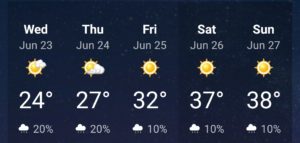
This week’s weather forecast – hot and hotter (from the Weather Network)
Most people know that when it’s hot out, they need to drink more, but are concerned that caffeine-containing drinks such as iced coffee, tea, or matcha—or various types of sodas such as cola—can cause dehydration. But is it true?
While caffeine is a mild diuretic (makes you urinate more), a 2014 study which compared the effect of drinking coffee with the effects of drinking the same amount of water found no difference in hydration status between the two groups. In the study [1], fifty men who usually drank 3-6 cups of coffee per day were asked to drink 4 x 200 ml cups of coffee containing 4 mg/kg caffeine per day for 3 days, while having their total body water calculated. Then the men switched and drank 4 x 200 ml of water for 3 days, while having total body water calculated, and during both arms of the study, amounts of physical activity, food and other fluids were controlled for.
The study found that there were no differences in several markers of hydration status between the groups—so no, caffeine won’t dehydrate you. However, for many, too much caffeine interferes with sleep, gives them headaches, or causes them to feel agitated or nervous. As well, for those with Gastroesophageal Reflux Disease (GERD), caffeine can increase heartburn because it relaxes the lower esophageal sphincter (LES)—resulting in the contents of the stomach more easily backing up into the esophagus.
[Image of the human digestive system]
But what’s the alternative? Plain water is a choice, but some find it boring. Others enjoy bottled club soda or make their own using a Sodastream, but some people can’t tolerate carbonated drinks, so what’s left?
How About Limonana?
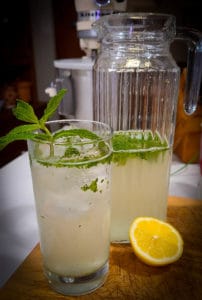
A refreshing glass of homemade Limonana
Limonana is a drink that I only learned about a few years ago. Since I first wrote about it in 2016, I have lost more than 50 pounds and put my type 2 diabetes and high blood pressure into remission, so I no longer make the sugary version. The recipe below is what I am making now.
“Limonana” is named for its two main ingredients: lemon and mint. In both Arabic or Hebrew, “limon” means lemon, and “nana” means mint. It is a wonderfully refreshing drink for the hottest of days.
I make Limonana using a sugar-free Monk Fruit and erythritol sweetener, so it is very low in carbohydrates and doesn’t spike insulin or blood glucose. There are two essentials: it must be made with fresh lemons (including the pulp), and it must be served over lots of ice.
Limonana Recipe
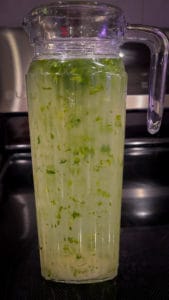
Limonana is ready to serve
- 3 lemons
- 16-20 fresh mint leaves
- 4 Tbsps. Monk Fruit/erythritol sweetener (or to taste)
- 450 ml cold water
- A whole tray of ice cubes
- Sprig of mint to garnish (optional)
Instructions
- Dissolve the sweetener in a bit of hot water and set aside.
- Remove the peel from the lemons and cut off all the white pith. Separate the lemon flesh from the membranes. Discard membranes and seeds; put the flesh into a blender.
- Add the mint and sweetener and pulse until the mint leaves are well chopped. Add the cold water and pulse again to mix.
- Allow to chill in the fridge to let the flavour mature.
- When ready to serve, pour over plenty of ice cubes in a tall glass.
Enjoy!
To your good health!
Joy
You can follow me on:
Twitter: https://twitter.com/JoyKiddie
Facebook: https://www.facebook.com/BetterByDesignNutrition/
References
- Killer SC, Blannin AK, Jeukendrup AE. No evidence of dehydration with moderate daily coffee intake: a counterbalanced cross-over study in a free-living population. PLoS One. 2014;9(1):e84154. doi:10.1371/journal.pone.0084154 [https://journals.plos.org/plosone/article?id=10.1371/journal.pone.0084154]

© 2025 BetterByDesign Nutrition Ltd.

I am a Registered Dietitian Nutritionist and the owner of BetterByDesign Nutrition Ltd. With a postgraduate degree in Human Nutrition and a background as a published mental health nutrition researcher, I have been dedicated to supporting my clients’ clinical needs since 2008.
I hold active professional licenses in BC (CHPBC), Alberta (CDA), and Ontario (CDO), allowing me to provide regulated Medical Nutrition Therapy across these provinces. My expertise spans chronic disease management, complex digestive health, and therapeutic diets. I am deeply passionate about helping people reclaim their health, rooted in my firm belief that Nutrition is BetterByDesign©.