
Introduction
There continues to be a reliance on LDL cholesterol (LDL-C) as the main means to assess cardiovascular disease (CVD) risk, despite the fact that apolipoproteinB (apoB) has been found to be a much better predictor. This article looks at why total LDL cholesterol is inadequate to assess cardiovascular risk, what apoB is, and why it is considered a better assessor, and how apoB, apoB/apoA rati,o and its proxy TG:HDL ratio could be used to assess CVD risk.
Moving Beyond LDL-C
An article published in Current Opinion in Lipidology (April 16, 2021) [1] states;
“There is now a robust body of evidence demonstrating the superiority of apoB over LDL-C and non-HDL-C as a clinical marker of cardiovascular risk. LDL-C is not the appropriate marker to assess the benefits of statin / ezetimibe / PCSK9 therapy”
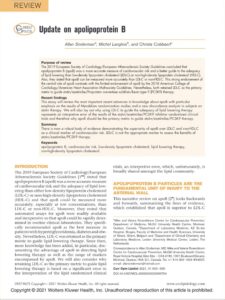 The paper outlines that in 2019 the European Society of Cardiology and the European Atherosclerosis Society Guidelines both concluded that apolipoprotein B (apoB) was a more accurate measure of cardiovascular risk and a better guide to using lipid lowering medication, than low-density lipoprotein cholesterol (LDL-C) or non-high-density lipoprotein cholesterol (HDL-C) — yet the American College of Cardiology and the American Heart Association continue to use both LDL-C as the primary means to assess CVD risk and to guide statin therapy.
To understand why apoB is a more accurate measure of cardiovascular risk than LDL, as well as how apoB/apoA ratio and its proxy triglyceride to HDL ratio (TG:HDL) can be used as a rough screening, a simple overview of the different types of cholesterol is needed — and it holds some surprises when it comes to both what we’ve believed about HDL being “good cholesterol”, and LDL being “bad cholesterol”.
Different Types of Cholesterol
What we call “cholesterol” is really lipoproteins, which are particles made up of lipids (fat) and protein, and that vary in size, density, and lipid and apolipoprotein composition. They can be separated into different classes based on physical and chemical parameters and include;
- high-density lipoprotein (HDL)
- low-density lipoprotein (LDL)
- very low density lipoprotein (VLDL)
The Role of High-Density Lipoprotein (HDL)
Most people think of high-density lipoprotein (HDL) as ”good cholesterol,” and while it is known as a strong inverse indicator of CVD risk, HDL cholesterol is not one entity; there are different sub-classes of HDL.
We have known since the 1990s that there are several sub-particles of LDL, and we now know that HDL is made up of 5 different sub-fractions based on their size and density (very large, large, medium, small, and very small), and that these five subclasses seem to be associated with different levels of CVD risk [2]. HDL cholesterol measured on blood tests measures the total cholesterol content in all the different sub-fractions of HDL (HDL-C)[2].
Each High Density Lipoprotein (HDL) carries one apolipoprotein-A (apoA), which makes up ~65% of its mass and has been found in most studies to not to be associated with CVD risk [2].
Some believe that when apoA is measured along with apoB (found in Very Low Density Lipoprotein (VLDL) and Low Density Lipoprotein (LDL)), it is an even stronger predictor of CVD risk than apoB alone [2]. More on this below. Some believe that any ratios (either apoA/apo B or TG:HDL) are problematic and that apoB alone should evaluate risk.
Is LDL Always “Bad Cholesterol”?
Most people think of low-density lipoprotein (LDL) as ”bad cholesterol” — but low-density lipoprotein (LDL) is not a single entity, either — but is made up of four subclasses of LDL particles [2] where decreased size and increased density of LDL are associated with increased cardiovascular risk [3,4].
It is the small, dense LDL sub-fraction (sdLDL) that is associated with atherosclerotic plaque, whereas the large, fluffy (or buoyant) LDL sub-fraction is not [3].
Here’s an analogy that may help you think of the different sub-fractions of LDL.
 If I have a basket filled with balls, is how many I can get inside a basket affected by whether they are basketballs or golf balls? Of course it is! I can put many more golf balls in a basket than I can basketballs. Think of golf balls as small, dense LDL (sdLDL) and basketballs as large, buoyant LDL.
The Limitation of Standard Lab Results
LDL cholesterol measured on lab tests indicates total LDL-cholesterol (LDL-C) — that is, the total concentration of cholesterol within all four sub-fractions of LDL sub-particles. What is very important to note is that total LDL cholesterol (LDL-C) is what is usually used in studies that report an association between higher levels of LDL and cardiovascular disease, but these studies fail to distinguish between small dense LDL, which are atherosclerotic, and the large, buoyant LDL, which are not. All the different subtypes of LDL are lumped together as if they were one thing — and they are very different!
Usually, when someone is told their “cholesterol is high,” it usually means that their LDL cholesterol is high — but many doctors are unaware of the different sub-fractions of LDL and that it is only the small, dense LDL (sdLDL) ones that pose a risk. This is why I encourage my clients when told their LDL is high to ask, “Which LDL”?
Understanding Very Low-Density Lipoprotein (VLDL)
 Very low density lipoprotein (VLDL) is produced in the liver, and the best way to understand its role is to think of it as a ”taxi” which the liver makes and then releases into the bloodstream to shuttle triglycerides (TG) around the body, to the various tissues. VLDL cholesterol on blood test results isn’t actually measured, but is estimated as a percentage of the triglyceride value.
It is important to note that very low density lipoproteins (VLDL) and the Low Density Lipoproteins (LDL) that result after it off-loads its triglycerides each carry one apolipoprotein-B (apoB) molecule, and while a high VLDL value is said to be a risk for cardiovascular disease, a more accurate measure is Apolipoprotein B (apoB), the lipoprotein in VLDL.
Where Does LDL Come From?
Once a large amount of triglyceride (TG) has been offloaded in the tissues by the VLDL ”taxi”, it then becomes a new, smaller lipoprotein called low-density lipoprotein, or LDL, which contains mostly cholesterol and some protein. Some LDLs are removed from the circulation by cells around the body that need the cholesterol contained in them, and the rest is taken out of the circulation by the liver.
LDL is what is left once the VLDL, which is made by the body, has offloaded its triglyceride “passenger” to the tissues.
Assessing Cardiovascular Risk Markers
LDL-particle number (LDL-P) has a strong and independent association with the development of atherosclerosis, as well as with CVD events [2] and is considered a more accurate predictor of cardiovascular events than total LDL cholesterol (LDL-C) [2].
A nuclear magnetic resonance spectroscopy (NMR) lipid profile test directly measures the number of LDL particles (as well as HDL particles). For LDL particles, a value of less than 1.000 in nmol/L is considered ideal, a value of 1000-1299 is considered moderate, a value of 1300-1599 is considered borderline high, and a value >1600 is considered high.
Apolipoprotein B: The Direct Measure
Apolipoprotein B (apo B), which is the main lipoprotein in VLDL (and in LDL after the VLDL has offloaded its triglycerides to the tissues) is correlated with LDL particle number, which makes it a very good assessor of cardiovascular disease risk.
Remember, the golf ball/basketball analogy; the higher number of LDL particles means the more small, dense LDL particles there are. Some believe that an apoB/apoA ratio is an even better predictor of CVD risk, than ApoB alone [2], and that an apo B / apo A ratio of > 0.9 a risk for CVD. Others only consider apoB alone to be a strong assessor of cardiovascular risk.
Triglyceride to HDL (TG:HDL) Ratio
Measuring apoB requires special blood tests, but studies have found that an estimate of the size of the LDL can be calculated by dividing triglycerides (TG) by HDL-cholesterol (HDL-C) from a standard lipid panel.
One study from 2004 reported that almost 80% of people with a TG:HDL-C ratio of greater than 3.8 (when values are expressed in mg/dl) had mostly small, dense LDL particles, indicating cardiovascular risk. This same study found that more than 80% with a TG:HDL-C ratio of less than 3.8 (when values are expressed in mg/dl) had mostly large, fluffy LDL particles, indicating lower cardiovascular risk [5].
A 2005 study [6] reported that a TG:HDL-C ratio of 3.5 or greater was highly correlated with atherosclerosis in men, as well as insulin resistance and metabolic syndrome.
A 2014 [7] study found that a high TG:HDL-C ratio was a strong independent predictor of cardiovascular disease, coronary heart disease, and all-cause mortality both before and after adjustment for age, smoking, BMI, and blood pressure.
In Canada (as well as Europe), values are expressed as mmol/L, and the ratios are interpreted as follows [8];
- TG:HDL-C < 0.87 is ideal
- TG:HDL-C > 1.74 is too high
- TG:HDL-C > 2.62 is much too high
In the US, values are expressed in mg/dl and the ratios are interpreted as follows [8];
- TG:HDL-C < 2 is ideal
- TG:HDL-C > 4 is too high
- TG:HDL-C > 6 is much too high
While TG:HDL ratio can provide some indication of the size of LDL cholesterol/particle number, when LDL is very high, I recommend that a person have an apoB test. When that is not possible, I feel it is prudent to change the types and amounts of fat being eaten to lower overall LDL cholesterol.
Final Thoughts
If someone’s lab test results show they have high LDL cholesterol, all we know for certain is that the total concentration of cholesterol, counting all four sub-fractions of LDL sub-particles together, is high. This would be like telling someone that the total number of balls they have is 25 and then asking them if this will fit in their container — but not telling them if they were golf balls or basketballs. We need to know how big they are to know what “25” means.
Someone having “high LDL cholesterol,” i.e., high total LDL (LDL-C) tells us nothing in and of itself. We need to know about either particle size or particle number. This leaves two options;
An LDL-particle (LDL-P) test will indicate the LDL particle number, and the higher the number, the more small dense LDL the person would have. While not routinely done, I have had clients come to me with results from this specialized test. They had it done when their total LDL cholesterol was found to be high, and their doctor wanted to know if this was problematic. If the number was low, then most of the LDL would be the large, buoyant type and not a problem — it would only be if the number was high, indicating lots of small, dense LDL, that high total LDL is indicative of CVD risk.
An apoB test, which measures the lipoprotein in VLDL and LDL, is a good indicator of LDL particle number and is a very good assessor of cardiovascular disease risk.
Being told we have high LDL cholesterol doesn’t mean much if we don’t know which LDL is high. Small, dense LDL is a risk, but large, buoyant LDL is not. To assess the need for dietary, lifestyle, or medication changes, we need to know ”how many” or ”how big”. We can estimate this using a TG:HDL ratio from routine blood work — all we need is a calculator and knowing the cut-off points. Then, if warranted, we can run an apoB test and know for sure if there are too many small dense LDL.
Prescribing statins on the basis of high (total) LDL cholesterol alone — without knowing anything about the size of the LDL particles or total number of LDL particles is, according to this most recent article, inappropriate.
NOTE (April 26, 2021): It should be noted that while it is the opinion of the writers of the article in Current Opinion in Lipidology, and that of the European Society of Cardiology and the European Atherosclerosis Society that LDL-C is not the best clinical marker of cardiovascular risk or the appropriate marker to assess the benefits of statin medication, an individual should always discuss whether or not to take a medication with their doctor. Lab tests may not be the only reason for medications to be prescribed — and such a recommendation may also include past medical history, lifestyle factors, and/or family risk factors. Always discuss these matters with your doctor.
More Info?
If you’ve been told you have high cholesterol and would like to know if dietary changes might be helpful, please reach out. I’ll review your blood work, personal and family history, and assess your diet, and we can discuss what I recommend in terms of the most prudent approach to minimize risk. You can view the Comprehensive Dietary Package here and learn about me.
To your good health!
Joy
You can follow me on:
Twitter: https://twitter.com/jyerdile
Facebook: https://www.facebook.com/BetterByDesignNutrition/
References
- Sniderman AD, Langlois M, Cobbaert C. Update on apolipoprotein B. Curr Opin Lipidol. 2021 Aug 1;32(4):226-230. [https://pubmed.ncbi.nlm.nih.gov/33870931/]
- Harada PHN, Akintunde A, Mora S. Advanced Lipoprotein Testing: Strengths and Limitations. American College of Cardiology. 2014. [https://www.acc.org/latest-in-cardiology/articles/2014/08/25/15/07/advanced-lipoprotein-testing-strengths-and-limitations]
- Diffenderfer MR, Schaefer EJ. The composition and metabolism of large and small LDL. Curr Opin Lipidol. 2014 Jun;25(3):221-6. [https://pubmed.ncbi.nlm.nih.gov/24811298/]
- Ivanova EA, Myasoedova VA, Melnichenko AA, Grechko AV, Orekhov AN. Small Dense Low-Density Lipoprotein as Biomarker for Atherosclerotic Diseases. Oxid Med Cell Longev. 2017;2017:1273042. [https://pubmed.ncbi.nlm.nih.gov/28572872/]
- Hanak V, Munoz J, Teague J, Stanley A Jr, Bittner V. Accuracy of the triglyceride to high-density lipoprotein cholesterol ratio for prediction of the low-density lipoprotein phenotype B. Am J Cardiol. 2004 Jul 15;94(2):219-22. [https://pubmed.ncbi.nlm.nih.gov/15246907/]
- McLaughlin T, Reaven G, Abbasi F, et al. Is there a simple way to identify insulin-resistant individuals at increased risk of cardiovascular disease? Am J Cardiol. 2005;96(3):399-404. [https://pubmed.ncbi.nlm.nih.gov/16054467/]
- Vega GL, Barlow CE, Grundy SM, Leonard D, DeFina LF. Triglyceride-to-high-density-lipoprotein-cholesterol ratio is an index of heart disease mortality and of incidence of type 2 diabetes mellitus in men. J Investig Med. 2014 Feb;62(2):345-9. [https://pubmed.ncbi.nlm.nih.gov/24402298/]
- Sigurdsson AF. The Triglyceride/HDL Cholesterol Ratio. Doc’s Opinion. Updated Jan 12, 2019. [https://www.docsopinion.com/2014/07/17/triglyceride-hdl-ratio/]

© 2025 BetterByDesign Nutrition Ltd.

Joy is a Registered Dietitian Nutritionist and owner of BetterByDesign Nutrition Ltd. She has a postgraduate degree in Human Nutrition, is a published mental health nutrition researcher, and has been supporting clients’ needs since 2008. Joy is licensed in BC, Alberta, and Ontario, and her areas of expertise range from routine health, chronic disease management, and digestive health to therapeutic diets. Joy is passionate about helping people feel better and believes that Nutrition is BetterByDesign©.