
If you are one of the many people that will be making a health-related New Year’s resolution this year, I’ve got some bad news for you. Half of people that make this type of resolution will have given up after only a week and 83% will have thrown in the towel by the end of January[1].
Why is that?
For one, it takes ~ 66 days (more than 2 months) for a new habit to become ingrained[2] and two, most New Year’s resolutions are wishes, more than a plan. More on that in a bit…
Yesterday I asked a question on Twitter:
“Are you making a New Year’s resolution this year and if so, is it to:
- lose weight
- exercise more
- eat healthier
- something else
Of the 62 people who completed the survey, here are the results:
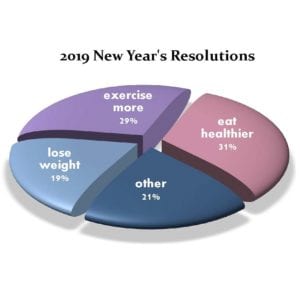
As you can see, they are pretty close, but of these 62 people, how many will actually meet their New Year’s Resolution? Based on a study on the outcome of New Year’s resolutions[1] referred to above, only 8% of people will meet their New Year’s resolution, so at the end of 2019, of the 62 people above;
- not even one person (0.94%) will have successfully achieved the weight loss they set out to
- a little more than one person (1.44%) will have been successful at consistently exercising more
- a little more than one person (1.54%) will have been successful at consistently eating healthier
- one person (1.04%) will have met their other health-related goal
This is not very encouraging, is it?
As I said above, most New Year’s resolutions are wishes, more than a plan. A wish is along the lines of “I’d like to” but without a well-thought-out, realistic plan to make that a reality.
There is hope!
Yesterday, I wrote an article titled Why I Suggest Avoiding These New Year’s Resolutions which explains how to set goals that will transform your health-related wish into an achievable goal. The steps are very straight-forward and if you want they can be completed between now and New Year’s or can be worked through during the month of January so that by the time 83% of people have given up on their New Year’s Resolutions, you will be primed to begin implementing your plan!
What I’d recommend is that you read through the article I wrote yesterday (link directly above), and if you need or want some help designing a plan, I have a special New Year’s SMART goal session that can help.
More Info
If you would like more information, you can learn about me here.
To your good health!
Joy
You can follow me on:
Twitter: https://twitter.com/jyerdile
Facebook: https://www.facebook.com/BetterByDesignNutrition/
Copyright ©2018 BetterByDesign Nutrition Ltd.
LEGAL NOTICE: The contents of this blog, including text, images and cited statistics as well as all other material contained here (the ”content”) are for information purposes only. The content is not intended to be a substitute for professional advice, medical diagnosis and/or treatment and is not suitable for self-administration without the knowledge of your physician and regular monitoring by your physician. Do not disregard medical advice and always consult your physician with any questions you may have regarding a medical condition or before implementing anything you have read or heard in our content.
References
- Norcross, JC et al, Auld lang syne: success predictors, change processes, and self-reported outcomes of New Year’s resolvers and nonresolvers. J Clin Psychol. 2002 Apr;58(4):397-405
- Lally, P., van Jaarsveld, C. H. M., Potts, H. W. W. and Wardle, J. (2010), How are habits formed: Modelling habit formation in the real world. Eur. J. Soc. Psychol., 40: 998—1009.

Joy is a Registered Dietitian Nutritionist and owner of BetterByDesign Nutrition Ltd. She has a postgraduate degree in Human Nutrition, is a published mental health nutrition researcher, and has been supporting clients’ needs since 2008. Joy is licensed in BC, Alberta, and Ontario, and her areas of expertise range from routine health, chronic disease management, and digestive health to therapeutic diets. Joy is passionate about helping people feel better and believes that Nutrition is BetterByDesign©.