
Note: This article was originally posted on August 28, 2018, and was updated on January 15, 2026
Introduction
While DEXA scans (Dual Energy X-ray Absorptiometry) are intended to measure bone mineral density, they also provide an accurate estimate of body fat percentage, but not everyone wants to or can go for this kind of testing to determine how much body fat they have. While most gyms and many pharmacies often have handheld impedance body fat analyzers, these can be affected greatly by changes in body water status, as can high-tech digital bathroom scales that have body fat analyzers built in.
Determining Body Fat Percentage based on BMI
Body Mass Index (BMI), calculated as your weight divided by your height squared, is the standard tool used to categorize people as normal weight, overweight, or obese. However, it is limited because it often misclassifies people’s actual body fat levels. For example, using a BMI of 30 as the marker for obesity misses nearly 50% of women who actually have a body fat percentage over 35%. According to the US Third National Health and Nutrition Examination Survey, BMI is only 94% accurate for women and 82% accurate for men when it comes to correctly identifying clinical obesity. [1].
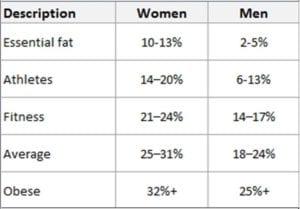
The body fat percentage chart below from the American Council on Exercise (ACE) is commonly used by trainers and gyms to determine body fat percentage, but it is limited as it is based solely on BMI.
Determining Body Fat Percentage Based on Anthropometrics
There are a number of equations based on body measurements (anthropometrics) that have been proposed as alternatives to BMI to better estimate whole body fat percentage. Some require more than 10 different measurements, others require up to 4 different skin-fold measurements using calipers, and even others are complex equations using multiple measurements. The common problem amongst all of the existing equations is a lack of simplicity, limiting their use in routine dietetic or medical practice.
Determining Body Fat Percentage Using Relative Fat Mass (RFM)
A study published in 2018 [1] systematically explored more than 350 anthropometric measurements to identify a simple linear equation that is more accurate than BMI at estimating whole body fat percentage in both men and women.
The equation [1] is amazingly simple:
Relative Fat Mass (RFM): 64 − (20 × (height/waist)) + (12 × sex), where sex = 0 for men and 1 for women
Click here for an article on how to accurately measure your waist circumference for use in this equation.
Compared with BMI, the Relative Fat Mass (RFM) equation was more accurate for body fat-defined obesity among both men and women over 20 years old, and RFM was more accurate than BMI for those with a high body fat percentage, and this accuracy held for those who were Mexican-Americans, European Americans, and African-Americans.
Looking at the equations another way, Relative Fat Mass (RFM) in both metric and American measurements is:
Relative Fat Mass (RFM) [1]:
Men: 64 — (20 x height/waist circumference)
Women: 76 — (20 x height/waist circumference)
How to Interpret Relative Fat Mass Results
Based on the research of Gallagher et al [2] and data from the World Health Organization, healthy body fat ranges have been determined as follows:
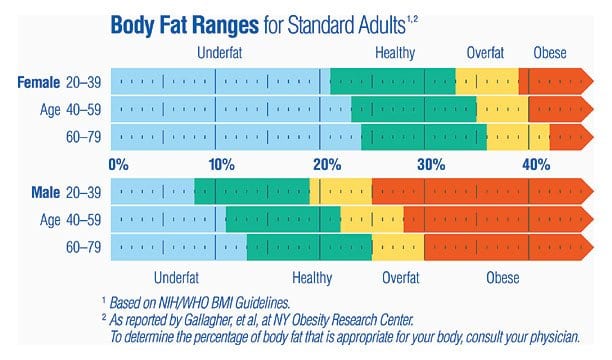
- In the case of Example 1, the 41-year-old male with an RFM of 32.2 would be considered at the low end of “obese”.
- The 60-year-old female of Example 2 with an RFM of 38.9 would be classified at the low end of “overfat”.
- The 50-year-old female of Example 3 with an RFM of 33.4 would be classified at the higher end of the “healthy” range.
Current Research on Relative Fat Mass (RFM)
There have been several major updates to the Relative Fat Mass (RFM) research, including a 2020 paper by the original authors, Woolcott and Bergman [3].
While the 2018 paper focused on estimating fat percentage, the 2020 paper established specific RFM cutoffs to diagnose obesity based on the association between RFM and all-cause mortality.
The researchers found that BMI significantly underestimates the prevalence of obesity in the U.S., particularly among women and older adults. The authors suggest that RFM cutoffs of 40% for women and 30% for men be used to diagnose obesity and identify individuals at higher risk of death [3].
- Obesity for Men: RFM ≥ 30%
- Obesity for Women: RFM ≥ 40%
Furthermore, the researchers highlighted that while BMI misses nearly 50% of women with obesity [1], the 2020 study showed that RFM correctly identified those same individuals with over 90% accuracy.
Woolcott also published a major update in December 2024 [4], which demonstrated that Relative Fat Mass (RFM) is a superior predictor of mortality compared to both Body Mass Index (BMI) and traditional waist circumference, as it predicts death from diabetes-related complications.
The study found that individuals with high RFM scores have a significantly higher risk of dying from diabetes-related complications and heart disease, establishing RFM not just as a tool for estimating body fat, but as a critical clinical marker for predicting metabolic outcomes such as diabetes and heart disease [4].
Final Thoughts
Obesity is a significant risk factor for multiple chronic diseases and conditions, including diabetes, coronary artery disease, hypertension (high blood pressure), and certain types of cancer [1,4]. Relative Fat Mass (RFM) is a very simple equation that accurately estimates whole body fat percentage, as well as the risk of dying from diabetes or heart disease.
The use of Relative Fat Mass (RFM) enables clinicians such as myself to easily help people better understand their risk while supporting them in the dietary and lifestyle changes needed to reduce it.
More Info
If you would like more information, you can learn about me and the Comprehensive Dietary Package that I offer.
To your good health!
Joy
You can follow me on:
Twitter: https://twitter.com/jyerdile
Facebook: https://www.facebook.com/BetterByDesignNutrition/
References
- Woolcott OO, Bergman RN. Relative fat mass (RFM) as a new estimator of whole-body fat percentage: a cross-sectional study in American adult individuals, Scientific Reports; Volume 8, Article number: 10980 (2018), https://www.nature.com/articles/s41598-018-29362-1
- Gallagher, D. et al. Healthy percentage body fat ranges: an approach for developing guidelines based on body mass index. Am J Clin Nutr 72, 694—701 (2000).
- Woolcott, O. O., & Bergman, R. N. (2020). Defining cutoffs to diagnose obesity using the relative fat mass (RFM): Association with mortality in NHANES 1999–2014. International Journal of Obesity, 44(6), 1301–1310. doi: 10.1038/s41366-019-0516-8
- Woolcott, O.O., Samarasundera, E., & Heath, A.K. Association of relative fat mass (RFM) index with diabetes-related mortality and heart disease mortality. Sci Rep 14, 30823 (2024). https://doi.org/10.1038/s41598-024-81497-6


Joy is a Registered Dietitian Nutritionist and owner of BetterByDesign Nutrition Ltd. She has a postgraduate degree in Human Nutrition, is a published mental health nutrition researcher, and has been supporting clients’ needs since 2008. Joy is licensed in BC, Alberta, and Ontario, and her areas of expertise range from routine health, chronic disease management, and digestive health to therapeutic diets. Joy is passionate about helping people feel better and believes that Nutrition is BetterByDesign©.