
This recipe in the article below was originally written and posted on January 17, 2018. This post was written on August 12, 2026, and updated on August 14, 2026.
Does 100% Avocado Oil Mayonnaise Have Other Oils in It?
Yes, a recently published study from UC Davis reported that forty-eight of 54 avocado oil-labeled products (89%), including two popular brands of avocado mayonnaise available in Canada (Chosen Foods, Primal Kitchen), showed composition patterns inconsistent with those of authentic avocado oil, meaning they contained oils other than 100% pure avocado oil [1]. Other brands of avocado mayo available in the US also failed, but one brand (Groves Avo Yeah! from New Zealand) passed.
“Most mayonnaise samples and all avocado oil salad dressings fell outside the Codex standard ranges for C16:0, C16:1 and C18:0 [1].”
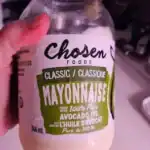 Until now, many consumers, including myself, bought products labelled 100% avocado oil because we didn’t want to eat refined seed oils, such as canola and soybean oil. You can read about the manufacture of these so-called “vegetable oils” to understand why I don’t use them and why I recommend alternatives such as single-source (not blended) cold-pressed olive oil, or walnut or macadamia nut oil for salads.
What About Olive Oil Mayonnaise?

Many people buy what they think is olive oil mayonnaise because they want to avoid refined, seed oils such as canola, but they don’t realize that these are seed oil mayonnaise, with added olive oil. The front label on the popular brand to the right reads “made with” in fine print, off to the side, but the first item on the list of ingredients is canola oil.
For this reason, I encourage people to read a product’s ingredient label, which lists ingredients in descending order by weight so the ingredient that is present in the highest amounts will be listed first.
What is an Alternative to Commercial Avocado Mayonnaise?
When I read the study, the alternative to adulterated avocado mayo was simple. I decided to go back to making my own, which is very easy and keeps very well.
Below is my tried-and-true recipe from January 2018, and if you’ve never made mayo before, know that small batches require little to no special equipment.
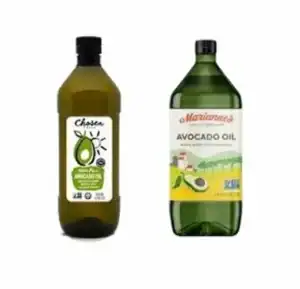
If you like the taste of avocado oil mayonnaise, a previous study from 2020 at UC Davis found that bottled avocado oil sold by Chosen Foods was one of only two brands that passed for both purity and quality [2,3]. Hopefully, that is still the case.
“Only two brands produced samples that were pure and nonoxidized. Those were Chosen Foods and Marianne’s Avocado Oil, both refined avocado oils made in Mexico.[3]”
Is Making Homemade Mayonnaise Difficult?
 No, making homemade mayonnaise is very easy. The key to success is having all your ingredients at room temperature before you begin. It can be made by hand in small amounts with a fork or a whisk in a bowl, and for larger amounts, it can be made in a metal pitcher with an immersion blender. I’ve even made it in a small food processor by adding the oil very slowly and blending well before adding more.
I use pasteurized eggs to ensure food safety, but if you raise your own chickens, you may choose to avoid that. Pasteurized eggs are available for purchase in the US, but I’ve been unable to find them in Western Canada, so since I started making homemade mayo, I have followed the instructions in the link available in the References below. Pasteurizing eggs is easy. All you need is an accurate thermometer and a few minutes [4].
Note: Since temperature and time accuracy are critical to food safety, I pre-calibrate my cooking thermometer using boiling water (100° C) to be sure the reading is accurate, especially if I will be serving the mayo to someone pregnant or who may have a compromised immune system.
What Types of Oil Are Best For Making Mayonnaise?
Any oil that remains liquid at room temperature can be used to make homemade mayo; however, the one you choose will significantly affect the flavor and texture of the final results.
While I love using single-origin cold-pressed extra-virgin olive oil for preparing food, I’ve found that it tastes too heavy in homemade mayonnaise. Also, when spun at high speeds such as with an immersion blender or food processor, bitter compounds (polyphenols) are released from the olive oil, resulting in an unpalatable mayonnaise. Some people will opt for “light-tasting” olive oil, which is refined to filter those strong flavors out.
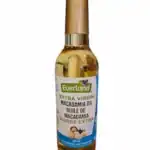 If you like the taste of avocado oil mayonnaise, two brands, Chosen Foods and Marianne’s, passed both purity and quality testing in 2020 [3]. Personally, I’ve never been that fond of the taste of avocado mayonnaise and really only bought it for convenience. I will likely go back to using cold-pressed extra virgin macadamia nut oil, which has a smooth, buttery flavour that is not overpowering.
 UPDATE (August 14, 2026): Someone who follows me on social media was kind enough to reach out to share the following information. At the end of July 2026, Consumer Labs published a review about avocado oil purity, freshness, and taste [5]; however, the purity results for national brands were based on the same UC Davis study from 2020 [3]. Additional testing by UC Davis in 2020 and 2021 and published in 2023 found similar purity problems in store-brands of avocado oil sold in the US [6], as was found in national brands in 2020 [3].
Walnut oil adds a distinct, intensely nutty flavour but also has a slightly bitter taste. Blending walnut oil with a more neutral oil (like avocado oil) is an option.
Almond oil or hazelnut oil are good choices if you want to experiment with a subtle, sweet, and nutty taste, but be aware that some brands are refined.
MCT oil can be used for therapeutic applications, but the resulting mayo will turn out less dense and thinner in texture and may cause digestive issues in sensitive people.
Homemade Mayonnaise Recipe
The most important thing to making a successful homemade mayonnaise is that all ingredients are at room temperature before beginning. Since I store my macadamia nut oil in the fridge once it’s open, I pull it out with my eggs at least 40 minutes ahead of time.
Ingredients
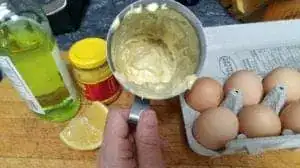
1/4 cup avocado or macadamia nut oil
1 cup avocado or macadamia nut oil
1 large egg, pasteurized
1/2 teaspoon Keen’s hot mustard
1/2 teaspoon salt
1/2 teaspoon white vinegar
1/2 lemon, juiced
Instructions

1 -Place the egg, mustard, and salt in a tall, thin metal pitcher and stir in only 1/4 cup of avocado or macadamia nut oil. Mix thoroughly.
2 -Insert a stick blender and turn it on high, then very slowly drizzle in the remaining cup of olive oil.
Note: Don’t rush this part, because adding the olive oil too fast will result in the mixture separating.
3 -After all the oil has been added and the mixture is emulsified, add the vinegar and lemon juice and stir gently with a spoon to blend.
4 – Store the mixture in the refrigerator in an airtight container.
More Info
If you would like support with healthy eating or weight management, you can learn about me and the Comprehensive Dietary Package that I offer.
To your good health.
Joy
You can follow me on:
Twitter: https://twitter.com/jyerdile
Facebook: https://www.facebook.com/BetterByDesignNutrition/
Reference
- Lopez-Alvarez N, Li X, Vizgordiski B, et al, Authenticity of avocado and olive oils used as ingredients in commercially processed foods, Applied Food Research, Volume 6, Issue 2, 2026, https://doi.org/10.1016/j.afres.2026.102389
- Green HS, Wang S, First report on quality and purity evaluations of avocado oil sold in the US, Food Control,
Volume 116, 2020, 107328, ISSN 0956-7135, https://www.sciencedirect.com/science/article/pii/S0956713520302449 - UC Davis Food News, Neilson D., Study Finds 82 Percent of Avocado Oil Rancid or Mixed With Other Oils – Food Scientist Says Standards Needed to Protect Consumers and Industry, June 15, 2020, https://www.ucdavis.edu/food/news/study-finds-82-percent-avocado-oil-rancid-or-mixed-other-oils
- Baking Bites, How to Pasteurize Eggs at Home, https://bakingbites.com/2011/03/how-to-pasteurize-eggs-at-home/
- Consumer Labs, Avocado Oil Review – Find the Best Avocado Oil for Purity, Freshness and Taste, July 30, 2026, www.consumerlab.com/reviews/avocado-oil-review/avocado-oil/
- Green HS, Wang S, Purity and quality of private labelled avocado oil, Food Control, Volume 152,
2023, 109837, ISSN 0956-7135, https://doi.org/10.1016/j.foodcont.2023.109837.
Quick Clinical Summary
Q: Is it true that avocado oil mayonnaise was found not to be 100 avocado oil?
A: Yes, a recently published study from UC Davis reported that 89% of avocado oil-labeled products, including popular brands of avocado mayonnaise, contained oils other than 100% pure avocado oil.
Q: Is it hard to make homemade mayo?
A: No, it is actually very easy. The trick is to make sure all your ingredients are at room temperature before beginning.
Q: Is Chosen Foods avocado oil 100% pure avocado?
A: A study at UC Davis found that in 2020, bottled avocado oil sold by Chosen Foods passed for both purity and quality.


I am a Registered Dietitian Nutritionist and the owner of BetterByDesign Nutrition Ltd. With a postgraduate degree in Human Nutrition and a background as a published mental health nutrition researcher, I have been dedicated to supporting my clients’ clinical needs since 2008.
I hold active professional licenses in BC (CHPBC), Alberta (CDA), and Ontario (CDO), allowing me to provide regulated Medical Nutrition Therapy across these provinces. My expertise spans chronic disease management, complex digestive health, and therapeutic diets. I am deeply passionate about helping people reclaim their health, rooted in my firm belief that Nutrition is BetterByDesign©.